








Wood Flour Loading vs HDPE Matrix Ratio: Why 60:40 vs 50:50 vs 70:30 Determines Flexural Modulus and Water Absorption in ASTM D7032 Pool Deck Applications

1. Why the Wood Flour to HDPE Ratio Drives the Pool Deck Decision
The wood flour to HDPE ratio is the single biggest formulation lever on a Wpc Deck board. It sets the flexural modulus, the water absorption, the biological weathering rate, the screw-holding capacity, the surface hardness, and the published ASTM D7032 performance figures. A buyer who specifies the right ratio for pool deck service gets a deck that holds its color, its stiffness, and its water-resistance over the published service life. A buyer who specifies the wrong ratio pays for repair costs in years 3-5.
For a pool Deck Wpc, three ratios dominate the conversation: 50:50, 60:40, and 70:30. Each sits at a different point on the modulus-versus-water-absorption trade-off, and each suits a different service environment. The rest of this article walks through the three ratios side by side, then explains how the coupling-agent chemistry and the ASTM D7032 test methods set the procurement specification, and closes with the per-piece price tier math a buyer needs to send with the inquiry.
The unit-by-unit perspective matters: a buyer who quotes a residential 200 m² pool deck sees a different ratio decision than a buyer quoting a 2,000 m² commercial boardwalk. The wood flour to HDPE choice follows the spec, not the other way around.
2. Quick Reference Chart — Wood Flour:HDPE Ratio Formulation Snapshot
The chart below summarizes the line items a WPC procurement team typically walks through when comparing the three ratios. The mechanical-property figures are drawn from the published formulation literature; the water-absorption figures are drawn from the published ASTM D7032 test-method data on commercial WPC products. Exact values depend on the wood-flour mesh size, the coupling-agent grade, and the extrusion process parameters.
| Property | 50:50 Wood:HDPE | 60:40 Wood:HDPE | 70:30 Wood:HDPE | What this means on the project |
|---|---|---|---|---|
| Wood flour (wt %) | ~50% | ~60% | ~70% | Higher loading raises stiffness and water absorption together |
| HDPE matrix (wt %) | ~50% | ~40% | ~30% | Thinner matrix means thinner encapsulation of fibers |
| Coupling agent (MAPE) | 2-3% | 3-4% | 4-5% | Higher wood loading needs more coupling to bond the interface |
| Flexural modulus (typical) | ~2,000-2,500 MPa | ~2,800-3,400 MPa | ~3,800+ MPa | Higher modulus supports wider joist spacing but lowers impact strength |
| Flexural strength (typical) | ~20-25 MPa | ~25-32 MPa | ~30-35 MPa | Same trade-off as modulus |
| Water absorption (24 h) | ~0.5-1.0% | ~1.0-1.8% | ~2.0-3.5% | ASTM D7032 caps the practical limit; absorption drives swelling |
| Thickness swell (24 h) | ~0.3-0.5% | ~0.5-1.2% | ~1.5-2.5% | Higher absorption correlates with higher visible swell in service |
| UV / fade resistance | Excellent | Good | Limited | Matrix-rich formulations accept UV stabilizer more uniformly |
| Biological weathering | Slow | Moderate | Faster | Higher fiber exposure raises fungal attachment risk |
| Screw-holding (face) | Good | Better | Brittle | Higher wood load improves face pull-out but lowers impact strength |
| Relative per-piece cost | 1.0× baseline | ~0.95-1.00× (less HDPE resin) | ~0.90-0.95× (least HDPE resin) | Wood flour is cheaper than HDPE by weight |
| Best service application | Residential pool deck | Commercial boardwalk, balcony | Dry cladding, fencing | Pick the ratio to the splash-zone exposure |
Reading a WPC formulation sheet line by line against the pool deck drawing is the engineering exercise that prevents the most common outdoor decking sourcing mistakes. The next sections explain what each line on the chart actually constrains.
3. Flexural Modulus — Why 60:40 Commercial Specification Beats 70:30
Flexural modulus rises with wood flour loading because the wood fibers are stiffer than the HDPE matrix. Published data trends: 50:50 formulations typically deliver flexural modulus around 2,000-2,500 MPa, 60:40 formulations reach 2,800-3,400 MPa, and 70:30 formulations can pass 3,800 MPa. The trade-off is that as modulus rises, the impact strength and the screw-holding capacity drop because the composite becomes more brittle.
For a pool deck, the flexural modulus picks the joist spacing. A 50:50 formulation at 2,200 MPa is comfortable on 400 mm joist spacing with a standard residential live load. A 60:40 formulation at 3,000 MPa carries the same load on 500 mm joist spacing — useful on commercial decks where wider joist spacing reduces the sub-frame material cost. A 70:30 formulation at 3,800 MPa is over-spec on residential decks and reaches the brittle-impact ceiling on commercial projects where dropped pool equipment or furniture rearrangements are routine.
For a residential pool deck where the deck span is in the 350-450 mm range, the 50:50 formulation is the cost-optimized pick. For a commercial boardwalk with spans in the 500-600 mm range, the 60:40 formulation is the right pick. The 70:30 formulation does not make engineering sense for any standing-deck pool application; it fits better on dry cladding or fencing where stiffness matters and water absorption does not.
4. Water Absorption — Why the 70:30 Ratio Crosses the Practical Ceiling
Wood flour is hygroscopic — wood fibers absorb and release water with humidity and direct splash. As the wood flour loading rises from 50 to 60 to 70 percent, the HDPE matrix thins around the fibers and cannot fully encapsulate them. The exposed fiber surfaces and the fiber-matrix interface become water-entry paths, and the published water absorption figure rises sharply.
The published water-absorption trend at 24-hour immersion:
- 50:50 formulation: approximately 0.5 to 1.0 percent by mass
- 60:40 formulation: approximately 1.0 to 1.8 percent by mass
- 70:30 formulation: approximately 2.0 to 3.5 percent by mass
For a pool deck where the splash-zone exposure sustains 8 to 12 hours of wet-dry cycling per day across the swimming season, those absorption figures translate directly into thickness swell, surface roughness, and fastener-loosening over a 5-year service window. The 70:30 formulation behaves closer to a compressed-wood panel than to a polymer composite in this service environment, which is why ASTM D7032 and EN 15534 both set practical ceilings on the wood flour loading for outdoor load-bearing applications.
A buyer who wants a published water-absorption figure should ask for the 24-hour immersion test data on the supplier's data sheet and compare it against the ASTM D7032 or EN 15534 limit at the formulation being quoted.
5. Coupling Agent Chemistry — How MAPE Bridges the Wood-Plastic Interface
Commercial WPC formulations for outdoor decking typically use a maleic anhydride-grafted polyethylene (MAPE) coupling agent at 2-5 percent by weight. The MAPE bridges the wood fiber surface (hydrophilic, water-loving) and the HDPE matrix (hydrophobic, water-hating), improving the interfacial bond and the resulting mechanical properties.
The coupling-agent chemistry explains why a 50:50 formulation can outperform a 70:30 formulation on water absorption even though it has less wood. A higher wood loading needs more MAPE per unit of fiber surface to keep the interface fully bonded. The MAPE percentage scales linearly with wood loading on commercial production lines:
- 50:50 formulation: 2-3 percent MAPE on the wood side
- 60:40 formulation: 3-4 percent MAPE on the wood side
- 70:30 formulation: 4-5 percent MAPE on the wood side
Without the MAPE coupling agent, even a 50:50 formulation underperforms because the fiber-matrix interface is a water-entry and stress-concentration path. A buyer who sends an inquiry that names the wood flour mesh size, the MAPE coupling-agent grade, and the wood-to-HDPE ratio gets a quote that matches the operating environment rather than a generic datasheet match.
6. ASTM D7032 Compliance — What Test Data the Supplier Must Publish
ASTM D7032 is the U.S. standard specification for establishing performance ratings for wood-plastic composite deck boards, stair treads, guards, and handrails. The standard sets the test methods, the load rating procedure, and the durability requirements for outdoor WPC products used in residential and commercial applications. A buyer who specifies ASTM D7032 compliance gets a published set of mechanical and durability data that can be compared across suppliers.
The ASTM D7032 test suite covers six categories that matter for pool deck specification:
- Flexural performance — flexural modulus and flexural strength per ASTM D6109, the load rating procedure for residential and commercial occupancy.
- Water absorption and thickness swell — 24-hour immersion test, the figure that drives the pool-deck splash-zone decision.
- UV resistance — ASTM G155 xenon-arc exposure, the figure that drives the published fade warranty.
- Freeze-thaw durability — ASTM D7032 cycle test, the figure that drives cold-climate pool deck service.
- Biological resistance — fungal and termite resistance, the figure that drives the published outdoor service life.
- Slip resistance — published coefficient of friction, the figure that drives the poolside barefoot-traction decision.
The European equivalent is EN 15534 for wood-plastic composite products; a buyer quoting a European municipal deck should request both standards' test data on the published data sheet. A reputable supplier publishes all six test results on the data sheet and lists the standard number for each test.
7. Pool Deck Splash-Zone Procurement Pitfalls
Walking through the most common specification mistakes on a pool deck WPC project explains why buyers who send a careful spec save time on the back-and-forth and get a better match on the finished deck.
- Specifying 70:30 because the per-piece cost is the lowest. The per-piece cost saving disappears when the deck shows visible swell in year 2 and the fasteners back out by year 3. The 50:50 formulation is the right baseline for residential splash-zone service.
- Specifying 60:40 for residential decks without checking the joist spacing. A residential 400 mm joist spacing is well within the 50:50 modulus envelope; specifying 60:40 buys stiffness the deck does not use.
- Underspecifying the coupling agent. A formulation without MAPE will fail the ASTM D7032 water absorption limit regardless of the wood-to-HDPE ratio. The MAPE percentage belongs on the spec sheet.
- Forgetting the UV stabilizer package. Pool decks see sustained UV exposure on the dry side. A formulation with insufficient UV stabilizer fades within 18 months; a properly stabilized 50:50 formulation keeps its published color for 5+ years.
- Specifying the wood species without specifying the mesh size. Wood flour mesh size 40-80 is the standard outdoor decking range. A coarser mesh gives lower water absorption but lower surface finish; a finer mesh gives higher surface finish but higher water absorption. The right pick depends on whether the deck boards go through an embossing step or not.
- Not requesting the published ASTM D7032 test data. A buyer who wants comparable test data across suppliers should request the published ASTM D7032 test report on the data sheet. The report number and date is the only way to compare two formulations on a like-for-like basis.
These six pitfalls are the same ones that come up on pool deck procurement reviews. Walking through them with the supplier at the inquiry stage turns a confusing spec exchange into a one-pass quote.
8. Bulk Procurement Math for a Pool Deck WPC Order
Bulk procurement math for OEM WPC pool deck boards is driven by three numbers: the per-piece price (which drops as volume rises), the surface profile (embossed versus smooth, which sets the tooling premium), and the color batch minimum (which sets the lot-size restriction). Walking through the math explains how pool deck program buyers structure their orders.
- Per-piece price. Typical per-piece price tiers drop in steps at 500, 1,000, 3,000, and 5,000 m². The 50:50 wood-to-HDPE formulation is typically the cost-baseline; the 60:40 formulation is 3-5 percent cheaper because it uses less HDPE resin.
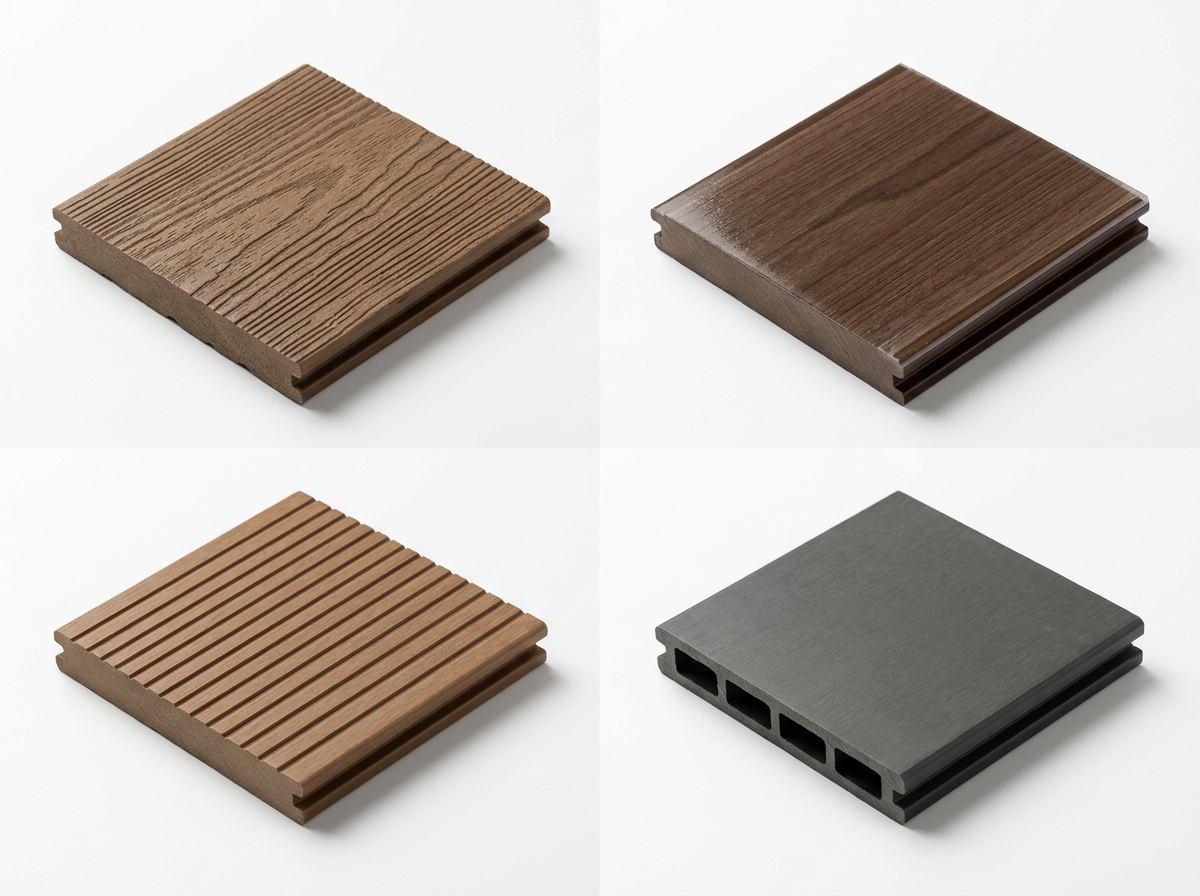
- Surface profile premium. A 3D embossed profile carries a higher per-piece price than a classic smooth profile because the embossing step is a secondary extrusion tool. The buyer should match the profile to the published application specification.
- Color batch minimum. A custom color (anything other than the standard gray, brown, or tan) carries a 5-10 ton minimum order because the color concentrate has to be batch-mixed at the extruder. The buyer should match the color to the stock palette where possible.
- Container load. A standard 20-foot container holds approximately 1,000-1,500 m² of 25 mm hollow-profile decking. The buyer should plan the order to the container load to optimize inbound freight.
- Annual program projection. For a 200 m² residential pool deck, a single order at the 500 m² tier covers two projects. For a 2,000 m² commercial boardwalk program, an annual order at the 3,000 m² tier covers the year with one container batch.
A buyer who walks through these five steps with the supplier's price sheet arrives at a per-piece price that the procurement and finance teams can sign off on, and at a wood-to-HDPE ratio that matches the actual splash-zone exposure.
9. Frequently Asked Questions
9.1 What is the best wood flour to HDPE ratio for a pool deck WPC?
The best wood flour to HDPE ratio for a pool deck WPC depends on the splash-zone exposure and the structural load. A 50:50 formulation balances flexural modulus, water absorption, and surface durability, and is the most common specification for residential pool decks. A 60:40 formulation pushes flexural modulus up at the cost of higher water absorption and faster biological weathering. A 70:30 formulation goes too far on stiffness and water absorption for sustained splash-zone service. For most ASTM D7032-compliant pool deck projects, 50:50 to 60:40 is the engineering range.
9.2 Why does a higher wood flour loading increase water absorption?
Wood flour is hygroscopic — wood fibers absorb and release water with humidity and direct splash. As the wood flour loading rises from 50 to 60 to 70 percent, the HDPE matrix thins around the fibers and cannot fully encapsulate them. The exposed fiber surfaces and the fiber-matrix interface become water-entry paths, and the published water absorption figure rises sharply. At 70 percent wood flour the WPC behaves closer to a compressed-wood panel than to a polymer composite, which is why ASTM D7032 sets a practical ceiling on the wood flour loading for outdoor load-bearing applications.
9.3 How does the wood flour to HDPE ratio change flexural modulus?
Flexural modulus rises with wood flour loading because the wood fibers are stiffer than the HDPE matrix. Published data trends: 50:50 formulations typically deliver flexural modulus around 2,000-2,500 MPa, 60:40 formulations reach 2,800-3,400 MPa, and 70:30 formulations can pass 3,800 MPa. The trade-off is that as modulus rises, the impact strength and the screw-holding capacity drop because the composite becomes more brittle. The right pick depends on whether the deck is structural (commercial boardwalk) or finished (residential pool surround).
9.4 What is ASTM D7032 and why does it matter for pool deck WPC?
ASTM D7032 is the U.S. standard specification for establishing performance ratings for wood-plastic composite deck boards, stair treads, guards, and handrails. The standard sets the test methods, the load rating procedure, and the durability requirements for outdoor WPC products used in residential and commercial applications. A buyer who specifies ASTM D7032 compliance gets a published set of flexural modulus, water absorption, UV resistance, and freeze-thaw cycle data that can be compared across suppliers. The European equivalent is EN 15534.
9.5 Does a 60:40 WPC formulation perform better than 50:50 in pool deck service?
A 60:40 WPC formulation delivers higher flexural modulus — useful on commercial boardwalks or where the deck spans wider joist spacing — but at the cost of higher water absorption and faster biological weathering in splash-zone service. A 50:50 formulation retains more HDPE around the wood fibers, lower water absorption, and longer fade and stain resistance. For a residential pool deck with standard joist spacing, the 50:50 formulation usually wins on total cost of ownership. For a commercial deck with wider spans, the 60:40 formulation is the right pick.
9.6 What coupling agent is used in commercial WPC formulations?
Commercial WPC formulations for outdoor decking typically use a maleic anhydride-grafted polyethylene (MAPE) coupling agent at 2-5 percent by weight. The MAPE bridges the wood fiber surface (hydrophilic) and the HDPE matrix (hydrophobic), improving the interfacial bond and the resulting mechanical properties. Without the MAPE coupling agent, even a 50:50 formulation underperforms because the fiber-matrix interface is a water-entry and stress-concentration path.