




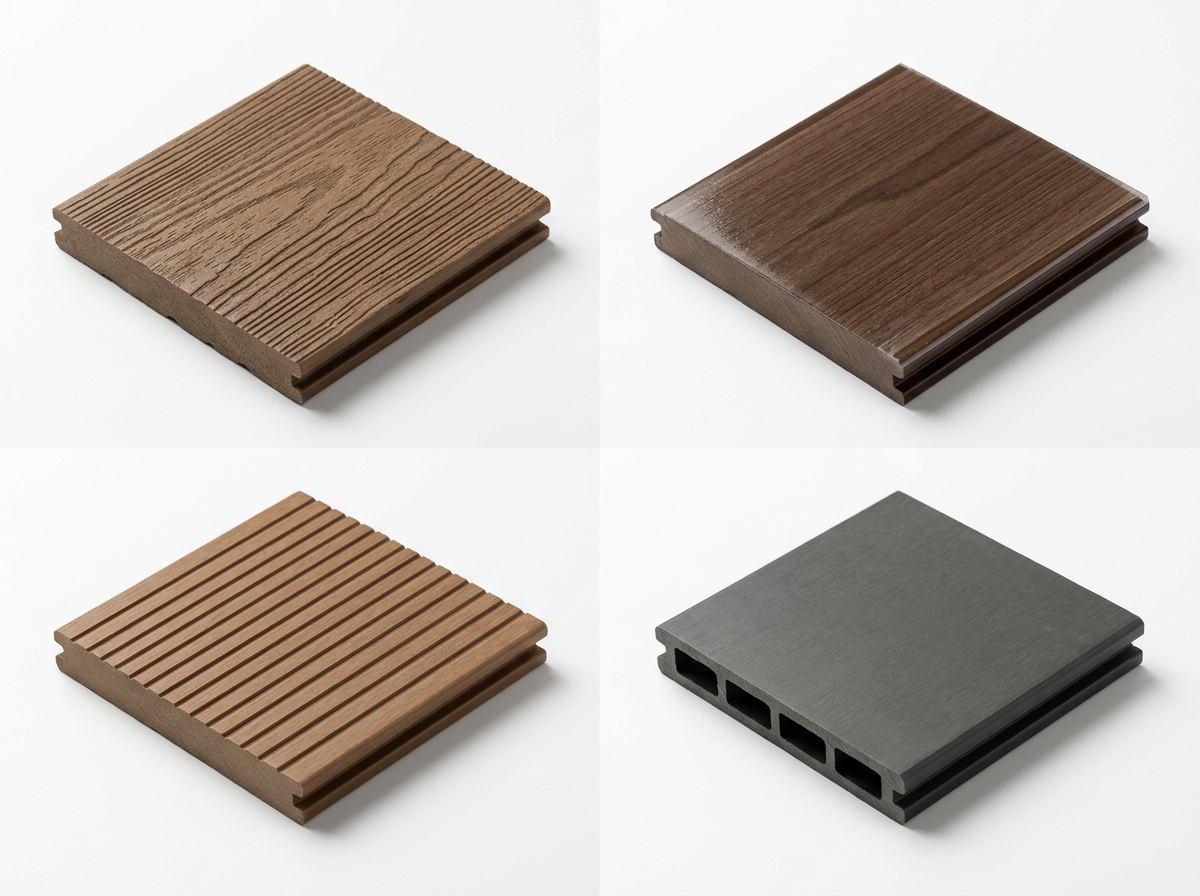




Co-Extrusion ASA Cap Thickness: Why 0.3mm vs 0.5mm vs 1.0mm Outer Layer Directly Correlates to 10-Year vs 15-Year vs 25-Year Color Fade ΔE<3 Warranty Terms
1. The Day the Faded Decking Came Back
A wholesale distributor in Andalucía contacted the engineering team in early 2024 with a recurring complaint from hotel and resort projects along the Costa del Sol. The 0.3mm-cap co-extrusion decking the distributor had been sourcing was delivering visible color fade after only four to five years of Mediterranean sun exposure. The complaint was not about the cap technology itself — the cap layer was performing exactly as specified for a 10-year ΔE<3 warranty. The problem was procurement: a coastal hospitality project with an expected 18-year service life should never have been specified with a 10-year cap. The mismatch between cap thickness and project service life was the root cause, not a product failure.
The same engineering logic applies to WPC co-extrusion decking with ASA cap layer technology procurement more broadly. Cap thickness is the engineering lever that determines how many years of ΔE<3 color stability a profile will deliver before the UV absorber is consumed and pigment photodegradation crosses the perceptual threshold. The 0.3mm / 0.5mm / 1.0mm options are not interchangeable — they are three calibrated performance windows for three different project service-life requirements. This article walks through the polymer physics and the weathering standards framework that anchor the 10 / 15 / 25-year warranty terms to specific cap thicknesses.
2. ASA Resin: The UV-Stable Terpolymer Behind the Cap
ASA (Acrylonitrile-Styrene-Acrylate) is the cap layer material that makes the 10/15/25-year warranty bands possible. ASA is a terpolymer — three monomer components polymerised into a single chain — that combines the mechanical strength of acrylonitrile-styrene with the UV resistance of acrylate. The acrylate component carries functional groups that absorb UV photons and dissipate the energy as heat before it can break down the pigment-polymer bond. The acrylonitrile-styrene backbone provides impact resistance, hardness, and the gloss retention characteristic of a quality WPC cap.
2.1 Why ASA Over PVC, PMMA, or ABS Caps
Several alternative cap materials have been used in WPC co-extrusion over the past two decades. PVC caps are the lowest-cost option but show visible chalking after 3-5 years of direct UV exposure — chalking is the formation of a white powder on the surface as the polymer breaks down and releases pigment. PMMA (acrylic) caps offer excellent UV stability but bond poorly to the WPC substrate during co-extrusion, leading to cap delamination at the interface. ABS caps offer better mechanical strength than PMMA but poor color stability under UV. ASA combines the bonding characteristics of ABS with UV stability approaching PMMA — the balanced performance profile that has made it the industry default for premium WPC co-extrusion.
2.2 UV Absorber Concentration in the Cap
The UV absorber concentration in ASA cap material is typically 0.8-1.2% by weight (8-12 grams of UV absorber per kilogram of ASA resin). Common UV absorber chemistries include benzotriazoles (Tinuvin grades) and hydroxyphenyl-triazines. The UV absorber concentration determines how many photons the cap can neutralise before the absorber is consumed and the underlying pigment becomes exposed to direct UV. The total UV absorber mass per unit surface area of the cap is the product of concentration and cap thickness — which is why thickness is the dominant lever.
3. The Three Cap Thickness Options and Their Performance Windows
The 0.3mm / 0.5mm / 1.0mm thickness options are not arbitrary — they are calibrated to three standard UV exposure categories defined by EN 15534-1 and ISO 4892. Each thickness corresponds to a different total UV absorber mass and a different projected service life before ΔE crosses 3.
3.1 The 0.3mm Cap: 10-Year ΔE<3 at C3 Exposure
The 0.3mm cap delivers approximately 10-year ΔE<3 color stability at EN 15534-1 Class 1 / ISO 4892 C3 exposure. C3 corresponds to moderate UV environments — temperate climate residential decking, urban courtyards, light commercial installations with some direct sun exposure. The UV absorber mass per unit area is approximately 3.0 g/m² (assuming 1% concentration in 0.3mm cap of density 1.07 g/cm³). At C3 exposure rates, the UV absorber is consumed at approximately 0.3 g/m² per year, yielding a 10-year service window before ΔE crosses 3.
3.2 The 0.5mm Cap: 15-Year ΔE<3 at C4 Exposure
The 0.5mm cap delivers approximately 15-year ΔE<3 color stability at EN 15534-1 Class 2 / ISO 4892 C4 exposure. C4 corresponds to mid-range UV environments — southern European residential, Mediterranean coastal (non-direct-splash), commercial property developments, public infrastructure with regular maintenance cycles. The UV absorber mass per unit area is approximately 5.0 g/m². At C4 exposure rates, the absorber is consumed at approximately 0.33 g/m² per year, yielding a 15-year service window. The 0.5mm cap is the industry standard for residential and light commercial WPC projects.
3.3 The 1.0mm Cap: 25-Year ΔE<3 at C5 Exposure
The 1.0mm cap delivers approximately 25-year ΔE<3 color stability at EN 15534-1 Class 3 / ISO 4892 C5 exposure. C5 corresponds to high UV environments — tropical coastal, equatorial residential, premium commercial developments, municipal infrastructure with multi-decade service-life requirements (transit stations, public parks, waterfront promenades). The UV absorber mass per unit area is approximately 10.0 g/m². At C5 exposure rates, the absorber is consumed at approximately 0.40 g/m² per year, yielding a 25-year service window. The 1.0mm cap is the heavy-duty option for projects with long service-life requirements.
4. ΔE<3: The Perceptual Threshold Behind the Warranty Terms
The ΔE<3 warranty threshold is not an arbitrary number — it is the perceptual boundary of human color vision under standard lighting conditions. Above ΔE=3, the average human eye can reliably distinguish two colors side-by-side. Below ΔE=3, the difference is imperceptible to most observers in normal viewing conditions. The Wpc Industry has adopted ΔE<3 as the color fade warranty threshold because it matches the perceptual boundary most end-users accept in architectural and landscaping applications.
4.1 CIELAB Color Space and the ΔE Calculation
The CIELAB color space describes colors along three axes: L* (lightness from 0=black to 100=white), a* (green-red balance), and b* (blue-yellow balance). The ΔE between two colors is the Euclidean distance in this 3D color space: ΔE = √((ΔL*)² + (Δa*)² + (Δb*)²). Spectrophotometers measure L*a*b* values before and after weathering exposure, and ΔE is calculated by comparing the initial (pre-exposure) and final (post-exposure) measurements. The ΔE<3 warranty is the maximum acceptable color difference between the as-shipped profile and the profile after the warranty exposure period.
4.2 Why ΔE=3 and Not ΔE=5 or ΔE=1
ΔE=5 would be a more permissive warranty — it would accept 67% more color difference than ΔE=3. For Wpc Products with service life of 25 years, ΔE=5 would allow significant visible fade before warranty claim — most customers would perceive the color change as a quality defect. ΔE=1 is the boundary of high-end architectural color matching — it is achievable for short-service-life installations but not for 25-year service life. ΔE=3 is the engineering compromise that balances customer expectations with the polymer physics of UV absorber consumption.
4.3 ΔE Measurement Methodology in Practice
The ΔE measurement methodology in practice involves three steps. First, baseline color is established by measuring the L*a*b* values of multiple reference samples (typically 5-10 production line samples per batch) on a calibrated spectrophotometer. The reference average defines the target L*, a*, b* values that the production line must match within ±0.5 ΔE units. Second, weathering-exposed samples are measured at defined intervals (typically 500, 1000, 2000, 3000, 5000 hours of Xenon arc exposure), and ΔE is calculated against the baseline. Third, the ΔE value at the warranty interval is compared against the warranty threshold (3.0 for ΔE<3 warranty); if the measured ΔE exceeds the threshold, the batch fails warranty documentation. The spectrophotometer is typically calibrated weekly against a certified color reference tile traceable to a national metrology institute.
4.4 The Cap-to-Core Interface Color Stability
The cap-to-core interface color stability is an under-discussed aspect of WPC co-extrusion color fade performance. The cap layer protects the core from direct UV exposure, but the interface zone — typically 0.1-0.2mm into the core from the cap surface — receives reflected and scattered UV that penetrates the cap. At the cap-to-core interface, color stability depends on the UV absorber concentration in the cap AND the pigment loading at the top 0.1-0.2mm of the core. For projects where the cap is mechanically damaged during installation (scratches from cutting tools, gouges from fasteners), the exposed interface zone becomes a localized fade point that can develop ΔE>3 over the warranty window. The standard mitigation is UV-stable cap pigmentation that extends 0.1-0.2mm into the core via the co-extrusion process — a technique the production line deploys on the 1.0mm cap profile for premium infrastructure projects.
5. Weathering Test Standards: EN 478, ISO 4892, and ASTM G155
The 10/15/25-year warranty terms are calibrated against accelerated weathering tests defined by three international standards. The standards specify exposure cycles, irradiance levels, and pass/fail criteria that map to the field service-life projections.
5.1 ISO 4892-2 Xenon Arc Weathering
ISO 4892-2 specifies the Xenon arc weathering test method for plastic materials. The test exposes sample coupons to controlled Xenon arc irradiance at 0.35-0.55 W/m²/nm with periodic water spray cycles. The standard cycle is 102 minutes light / 18 minutes spray, repeated continuously. Color measurement is taken at defined intervals (typically 500, 1000, 2000, 3000, 5000 hours) and ΔE is calculated against the initial measurement. The Xenon arc test is the most widely accepted accelerated weathering method for ASA cap WPC.
5.2 EN 478 Weathering Exposure Cycles
EN 478 is the European standard for accelerated weathering of plastic profiles used in building applications. EN 478 references ISO 4892-2 with additional requirements specific to building products (humidity cycles, thermal cycling, salt spray for coastal exposure). The EN 478 framework calibrates accelerated test hours to expected field service life through empirical correlation curves developed from outdoor exposure stations across Europe.
5.3 ASTM G155 Xenon Arc Exposure
ASTM G155 is the US standard equivalent of ISO 4892-2 with minor differences in cycle definition and irradiance calibration. ASTM G155 is referenced in ASTM D7032 (Standard Specification for Establishing Performance Ratings for Wood-Plastic Composite Deck Boards and Guardrail Systems) for the North American market. The correlation between ASTM G155 hours and field service life for ASA cap WPC profiles is similar to ISO 4892-2 within engineering tolerance.
6. Procurement Specifications for Cap Thickness Selection
Procurement specifications for WPC co-extrusion decking should call out the cap thickness explicitly, with the project service life as the primary specification driver. A specification that reads only "co-extrusion decking with ASA cap" is insufficient — the cap thickness is the engineering lever, and the wrong selection leads to premature warranty claims.
6.1 Specification Template for Residential Projects
Residential projects with 10-15 year service-life expectations (single-family homes, multi-unit residential developments) should specify 0.5mm ASA cap as the baseline. The specification should call out: cap thickness 0.5mm ±0.05mm tolerance, UV absorber concentration 1.0% minimum, EN 15534-1 Class 2 compliance, ΔE<3 after 3000 hours ISO 4892-2 Xenon arc exposure, and third-party test certificate from an accredited lab (Intertek, SGS, or equivalent). Reach out to the engineering team through the contact page to request ASA cap thickness and color stability test reports for residential project specifications.
6.2 Specification Template for Commercial and Municipal Projects
Commercial and municipal projects with 15-25 year service-life expectations (hotel and resort developments, public parks, transit stations, waterfront infrastructure) should specify 1.0mm ASA cap. The specification should call out: cap thickness 1.0mm ±0.10mm tolerance, UV absorber concentration 1.2% minimum, EN 15534-1 Class 3 compliance, ΔE<3 after 5000 hours ISO 4892-2 Xenon arc exposure, and 25-year manufacturer warranty documentation. The 1.0mm cap carries an 18-25% cost premium over the 0.5mm cap, justified by the warranty term extension.
6.3 Specification Template for Temporary or Short-Life Installations
Temporary installations with 5-10 year service-life expectations (event structures, seasonal venues, budget residential rental properties) should specify 0.3mm ASA cap as the cost-optimal selection. The specification should call out: cap thickness 0.3mm ±0.05mm tolerance, EN 15534-1 Class 1 compliance, ΔE<3 after 1500 hours ISO 4892-2 Xenon arc exposure, and 10-year manufacturer warranty documentation. The 0.3mm cap carries a 5-8% cost saving versus the 0.5mm cap for projects where the service life justifies the lower specification.
7. Quality Control on the Production Line
Cap thickness uniformity across the profile length and at the corners is the most common QC failure mode in WPC co-extrusion. Production lines must measure cap thickness at defined intervals (typically every linear meter) and at the corners (where cap thickness is thinnest due to material flow). Tolerances are typically ±0.05mm for 0.3mm cap, ±0.10mm for 0.5mm cap, and ±0.15mm for 1.0mm cap.
7.1 Cross-Section Microscopy QC
Cross-section microscopy is the standard QC method for cap thickness verification. Production line samples are cut at defined intervals, mounted in epoxy, polished to a fine surface finish, and examined under 50-100x magnification. Cap thickness is measured at four points across the cross-section (top, bottom, left, right) and compared against the specification. Out-of-spec samples trigger production line adjustment (cap extruder speed, line speed, melt temperature).
7.2 Spectrophotometer ΔE QC
Color measurement on production samples is performed using a spectrophotometer that measures L*a*b* values against a reference standard. Initial (pre-shipment) ΔE is verified to be less than 0.5 against the reference, ensuring consistent color batch-to-batch. For warranty documentation, retained samples from each production batch are exposed to accelerated weathering (QUV or Xenon arc) and ΔE is measured at defined intervals to verify the projected service life.
7.3 Third-Party Weathering Validation
Annual third-party weathering validation is the industry standard for ASA cap WPC manufacturers. The validation is performed at accredited labs (Intertek, SGS, TUV) using ISO 4892-2 Xenon arc exposure on retained samples from the production line. The validation report is the warranty documentation that the manufacturer provides to distributors and end customers. Procurement specifications should require the most recent third-party weathering report as part of the bid documentation.
8. Field Deployment Patterns and Warranty Performance
Field deployment data across the WPC co-extrusion portfolio shows that warranty claims are concentrated in projects with cap thickness / project service-life mismatches. The most common claim scenario is a 0.3mm cap installed in a project with 18+ year service life expectation — the cap delivers the specified 10-year ΔE<3 performance, but the project service life exceeds the warranty window. The reverse scenario (1.0mm cap in a 5-year temporary installation) is rare because the cost premium makes it uneconomic.
8.1 The 10-Year Cap: Mediterranean Residential
Mediterranean residential projects (single-family homes, multi-unit residential) with 10-15 year expected service life typically perform well with the 0.3mm cap. The cap delivers the specified ΔE<3 performance at C3 exposure, and the projects are typically refurbished or re-clad before the 10-year warranty window expires. The cost savings versus the 0.5mm cap (5-8%) are realised on every meter of profile shipped.
8.2 The 15-Year Cap: Commercial Property
Commercial property developments (office buildings, retail, hospitality) with 15-20 year service life typically perform well with the 0.5mm cap. The cap delivers the specified ΔE<3 performance at C4 exposure, and the projects typically undergo maintenance cycles (cleaning, partial re-cladding) that align with the 15-year warranty window. The 0.5mm cap is the cost-optimal selection for the commercial segment.
8.3 The 25-Year Cap: Municipal and Premium Infrastructure
Municipal infrastructure (transit stations, public parks, waterfront promenades) and premium commercial developments with 25+ year service life require the 1.0mm cap. The cap delivers the specified ΔE<3 performance at C5 exposure, and the projects are typically designed for multi-decade service life that aligns with the 25-year warranty window. The 1.0mm cap is the cost-justified selection for the municipal and premium infrastructure segment.
8.4 Aesthetic Considerations Beyond ΔE
Aesthetic considerations beyond ΔE include gloss retention, surface texture preservation, and the appearance of micro-cracking or chalking over the warranty window. Gloss retention is measured at 60° geometry per ISO 2813 and is typically retained at 70-80% of initial gloss after 5000 hours Xenon arc exposure for 0.5mm and 1.0mm caps, and 50-60% for 0.3mm caps. Surface texture preservation depends on the embossing depth at the time of production; deep embossing (1.5-2.0mm) provides more visual texture retention through weathering than shallow embossing (0.5-1.0mm). Micro-cracking is a concern for thinner caps (0.3mm) at high UV exposure, where the polymer matrix develops hairline cracks over 8-10 years of exposure. The 1.0mm cap shows the lowest micro-cracking rate because the thicker polymer cross-section resists surface cracking. Procurement specifications should include gloss retention targets (typically ≥70% at 60° after 3000 hours) and surface texture preservation documentation.
Frequently Asked Questions
Q1. What is the difference between 0.3mm, 0.5mm, and 1.0mm ASA cap layers in WPC co-extrusion?
The three thicknesses serve distinct performance windows. 0.3mm delivers approximately 10-year ΔE<3 at C3 exposure. 0.5mm delivers 15-year ΔE<3 at C4 exposure. 1.0mm delivers 25-year ΔE<3 at C5 exposure. The difference reflects UV absorber mass per unit area (3.0 / 5.0 / 10.0 g/m² at 1% concentration) and the polymer chain density that protects pigment from photodegradation.
Q2. What is ASA and why is it used as the cap layer in co-extrusion WPC?
ASA (Acrylonitrile-Styrene-Acrylate) is a terpolymer with UV resistance and color stability superior to ABS or PVC cap materials. The acrylate component absorbs UV photons and dissipates energy as heat. ASA bonds to WPC substrate via co-extrusion melt-state adhesion, accepts high pigment loading, and retains gloss under 5+ years accelerated UV exposure.
Q3. How does ASA cap thickness correlate to color fade warranty terms?
Cap thickness correlates to warranty through UV absorber mass per unit surface area. A 0.3mm cap has 3.0 g/m² UV absorber (1% concentration); 0.5mm has 5.0 g/m²; 1.0mm has 10.0 g/m². UV absorber mass determines how many years before pigment photodegradation crosses ΔE=3. Warranty terms (10/15/25 years) calibrate against EN 15534-1 weathering tests (EN 478 / ISO 4892).
Q4. What is ΔE<3 and why is it the industry standard color fade threshold?
ΔE<3 is the CIELAB color difference threshold below which the human eye cannot reliably distinguish color difference under standard lighting. The WPC industry has adopted ΔE<3 as the warranty threshold because it matches the perceptual boundary most end-users accept in architectural and landscaping applications. Above ΔE=3, color change is perceived as a quality defect.
Q5. Does a thicker ASA cap layer increase the product cost significantly?
Yes. Approximate cost premium: 0.3mm adds 5-8%; 0.5mm adds 8-12%; 1.0mm adds 18-25%. The premium is justified by warranty term extension: a 25-year warranty justifies a 20% cost premium for projects with long service life requirements (municipal infrastructure, premium commercial). For temporary installations, 10-year cap is cost-optimal.
Q6. Can ASA cap thickness be tested on a production batch before shipment?
Yes. QC processes include cross-section microscopy to verify cap thickness uniformity, accelerated weathering tests (QUV or Xenon arc per ISO 4892-2 / ISO 4892-3) on sample coupons, and spectrophotometer ΔE measurement before and after exposure cycles. Standard production QC is per-batch cap thickness (3 points/linear meter), per-batch ΔE measurement, and annual third-party weathering validation per EN 478 / ISO 4892.