





Can a WPC Garden Fence Really Last Decades?

Yes, a Wpc Garden Fence genuinely lasts for decades. You can expect it to exceed 20-30 years with optimal conditions and proper care. Many manufacturers offer extensive10 to 25-year warranties. This reflects an average lifespan of 15 to 20 years, often longer. High-quality materials and professional installation significantly extend this duration.
Key Takeaways
- WPC fences last a long time. They resist rot, insects, and fading better than wood. This is because they mix wood and plastic.
- Good installation and quality materials make Wpc Fences last longer. Make sure to follow all instructions. This helps the fence stay strong.
- Clean your WPC fence often. Fix small damages quickly. Make sure water drains away from the fence. These steps keep your fence looking good for many years.
The Enduring Appeal of a WPC Garden Fence

Inherent Durability of WPC Material
You will find a WPC garden fence offers exceptional strength. Manufacturers create these materials by blending wood (up to 70% in forms like pellets or fibers) with a polymeric matrix, such as polyethylene or polypropylene. They also add crucial components like maleic anhydride. This additive acts as a coupling agent. It significantly improves the adhesion between wood and plastic. This process, called melt blending, occurs at high temperatures. It ensures the wood disperses well within the polymer. This combination results in a material with excellent mechanical properties. You get a beneficial mix of tensile strength, hardness, and flexural strength. This helps prevent warping and maintains the product's shape. Unlike traditional wood, WPC resists cracking or splintering, even under high mechanical stress or moisture fluctuations.
Resistance to Common Wood Problems
WPC materials are engineered to resist many issues that plague traditional wood. The plastic content creates a barrier against moisture. This makes your WPC garden fence less prone to rotting and molding. Additives further enhance moisture resistance. WPC boards are not subject to fungal growth or insect infestation. Termites and other wood-boring insects find WPC an unappealing food source. This composite nature means WPC does not absorb water, preventing swelling or decay. A scientific study showed WPC's high resistance to fungal decay, with only a minor mass loss after prolonged exposure. This inherent resistance significantly reduces your maintenance needs.
Long-Term Aesthetic Retention
Your WPC fence will maintain its beautiful appearance for years. Manufacturers integrate UV stabilizers into the material. These prevent color fading, often retaining 95% of the original hue for a decade. Color-stabilized composite cores ensure visual consistency across various temperatures. Some WPC products feature photocatalytic titanium dioxide coatings. These coatings use sunlight to break down organic contaminants like algae and dirt. Superhydrophobic nano-coatings also make the surface water-repellent. Rainwater forms spherical droplets that roll off, carrying away debris. This "lotus leaf effect" keeps your fence cleaner with less effort.
Key Factors Influencing WPC Garden Fence Lifespan
Several critical factors determine how long your WPC garden fence will last. You must consider the material's inherent quality, the installation process, and the environmental conditions it faces. Each element plays a vital role in achieving decades of performance.
Quality of WPC Material and Manufacturing
The quality of WPC material and its manufacturing process directly impacts your fence's longevity. Not all WPC is created equal. High-quality WPC uses specific formulations and advanced production techniques. You should look for products that meet stringent industry standards. These standards ensure the material performs as expected over time.
| Standard/Certification | Scope/Indication of Longevity |
|---|---|
| EN 14351-1 (European Standard for Windows and Doors) | Specifies safety requirements including wind pressure resistance, water resistance, air permeability, and mechanical stability, crucial for long-term performance. |
| GB/T 29418-2012 (China General Standard for WPC Materials) | Covers physical and chemical properties, ensuring weather resistance, strength, and environmental performance meet national requirements. |
| ASTM D7032 (American Standard for WPC Materials) | Addresses structural performance, flame retardant properties, and UV aging resistance, all vital for product longevity in the North American market. |
| GB 18580-2017 (Formaldehyde Release Limit Standard) | Ensures WPC materials are harmless to human health by limiting formaldehyde emissions, contributing to overall product safety and quality. |
| SGS Inspection Report | Involves testing for fire resistance, formaldehyde emission, and impact resistance, ensuring compliance with international and national standards for durability and safety. |
| ISO 9001 Quality Management System Certification | Guarantees consistent product quality and safety through a stable quality management system in manufacturing. |
| ISO 14001 Environmental Management System Certification | Focuses on minimizing environmental impact during production, indicating a commitment to green manufacturing and sustainable product quality. |
You also find specific performance tests indicate superior durability. For example, some WPC products undergo European Water Immersion Tests at 90°C, exceeding the standard 60°C. They also pass European UV Stability Tests for 3000 hours, surpassing the typical 2000-hour requirement. These rigorous tests confirm the material's ability to withstand harsh conditions.
Manufacturing methods also make a significant difference. Co-extrusion WPC flooring, often called second-generation WPC, offers superior performance compared to standard extrusion.
| Feature | Co-extrusion WPC Flooring | Standard Extrusion (Implied as first-gen WPC) |
|---|---|---|
| Process Principle | WPC substrate and a highly wear-resistant, weather-resistant polymer surface layer (e.g., PVC, ASA, PMMA) are simultaneously extruded to form a double-layer composite structure, with a denser surface layer (0.2–0.5 mm thick). | Produces durable, low-maintenance, and environmentally resistant products, but with an unprotected surface. |
| Core Features | Strong wear resistance (scratch-resistant), waterproof and anti-fouling (closed, non-porous surface prevents water seepage and mold), excellent color stability (anti-UV additives reduce fading), smooth touch. | Offers resistance to rot and insects. |
| Impact on Durability | Significantly enhanced durability due to protective polymer shell, prevents fading, scratching, staining, warping, and mold growth, leading to a longer lifespan. Multi-layer structure enhances weather resistance. | More vulnerable to environmental factors over time due to unprotected surface. |
| Maintenance | Low maintenance needs. | Requires more maintenance due to surface vulnerability. |
| Application | Suitable for commercial places, high-traffic areas, or humid environments (docks, balconies), prioritizing long-term durability and low maintenance. | General WPC applications where basic resistance to rot and insects is sufficient, but less demanding environments. |
| Overall Performance | Superior option, often referred to as second-generation WPC, due to enhanced UV and moisture resistance, and aesthetic retention. | First-generation WPC, generally less resistant to environmental degradation compared to co-extrusion. |
Co-extrusion creates a protective polymer shell around the WPC core. This shell significantly enhances durability. It prevents fading, scratching, staining, warping, and mold growth. This multi-layer structure greatly improves weather resistance, leading to a much longer lifespan for your fence.
Professional Installation and Structural Integrity
Even the highest quality WPC material requires professional installation to ensure its longevity. Proper installation guarantees structural integrity and prevents premature failure. You must follow manufacturer guidelines carefully.
Here are key steps for professional WPC fence installation:
- Prepare the Ground: Dig post holes approximately 1/3 the height of the post. This depth ensures stability.
- Install the Fence Posts: Insert posts, making sure they are level and aligned. Use concrete to secure posts for added strength. Maintain vertical alignment while the concrete sets.
- Install the Fence Panels: Attach the bottom rail level between posts. Slide or attach WPC fence panels onto rails. Secure each panel with screws or fasteners from the installation kit. Ensure proper spacing and alignment.
- Top Rail and Finishing: Install the top rail securely to the posts. This caps off the fence.
- Post-installation Check: Verify the alignment and stability of the fence after installation.
Another method involves specific steps for different ground types:
- Choose the Right Installation Method: Select between base mounting for concrete surfaces or direct burial for soil. Base mounting uses expansion bolts for stability. Direct burial requires burying posts approximately 2 inches deep for a sturdy foundation.
- Install the Bottom Rail: Attach this horizontal beam to fence posts using screws. It provides crucial structural integrity.
- Assemble the WPC Boards: Install six WPC boards from top down. Connect them without screws to create a seamless surface.
- Attach the Carved Aluminum Accents: Install these accents on top of the WPC boards. They enhance durability and provide additional strength.
- Install the Top Rail and Complete the Installation: Attach the top rail to cap off the fence. Ensure it is secure and visually cohesive. This design allows the fence to withstand winds up to force 10.
You must also consider thermal expansion and contraction. WPC materials expand when hot and contract when cold. This cycle can stress the structure. It can lead to warping, cracking, or detachment if not managed. Expansion joints absorb these movements. They provide space for the material to change size without causing damage. This ensures the longevity and durability of your WPC fence.
| Performance | Details |
|---|---|
| Coefficient of Thermal Expansion (CTE) | WPC materials, including those used in fence panels, exhibit thermal expansion and contraction. The CTE measures how much a material's size changes with temperature variations. A higher CTE means greater expansion and contraction, necessitating larger expansion gaps. |
| Impact on Structural Integrity | Significant thermal expansion and contraction, if not accommodated by proper expansion joints, can lead to structural stress. This stress can manifest as warping, buckling, cracking, or detachment of WPC fence panels from their supports. |
| Importance of Expansion Gaps | Expansion gaps are crucial for WPC fence panels to allow for natural movement without damage. These gaps prevent the buildup of compressive stress during expansion and tensile stress during contraction, preserving the material's integrity and appearance. |
| Factors Influencing CTE | The CTE of WPC can vary based on the composition of the material (e.g., wood fiber content, polymer type, additives). Manufacturers often provide specific CTE values for their products, which should be considered during installation. |
| Installation Considerations | Installers must account for the expected range of temperature fluctuations in the installation environment when determining the appropriate size of expansion gaps. Failure to do so can compromise the long-term performance and aesthetic of the WPC fence. |
| Long-term Durability | Properly managed thermal expansion and contraction through adequate expansion gaps contribute significantly to the longevity and durability of WPC fence panels, preventing premature wear and structural failures. |
Expansion gaps in WPC panels, including fence panels, are caused by:
- Temperature fluctuations: High heat causes expansion.
- Humidity changes: Moisture can lead to swelling.
- Improper installation: Incorrect spacing exacerbates issues. Failure to manage these gaps can result in misalignment, warping, or uneven surfaces.
Environmental Exposure and Climate Resilience
Your WPC garden fence must withstand various environmental challenges. Its resilience to climate conditions significantly impacts its lifespan. WPC excels in environments where traditional wood struggles, such as high humidity or saltwater exposure.
| Material | Water Absorption Rate | Mold Risk Level | Lifespan in Humid Climates |
|---|---|---|---|
| Pressure-Treated Wood | 18-22% | High | 5-7 Years |
| Standard PVC | 0.3-0.5% | Moderate | 10-15 Years |
| Premium WPC | <1.5% | Negligible | 25+ Years |
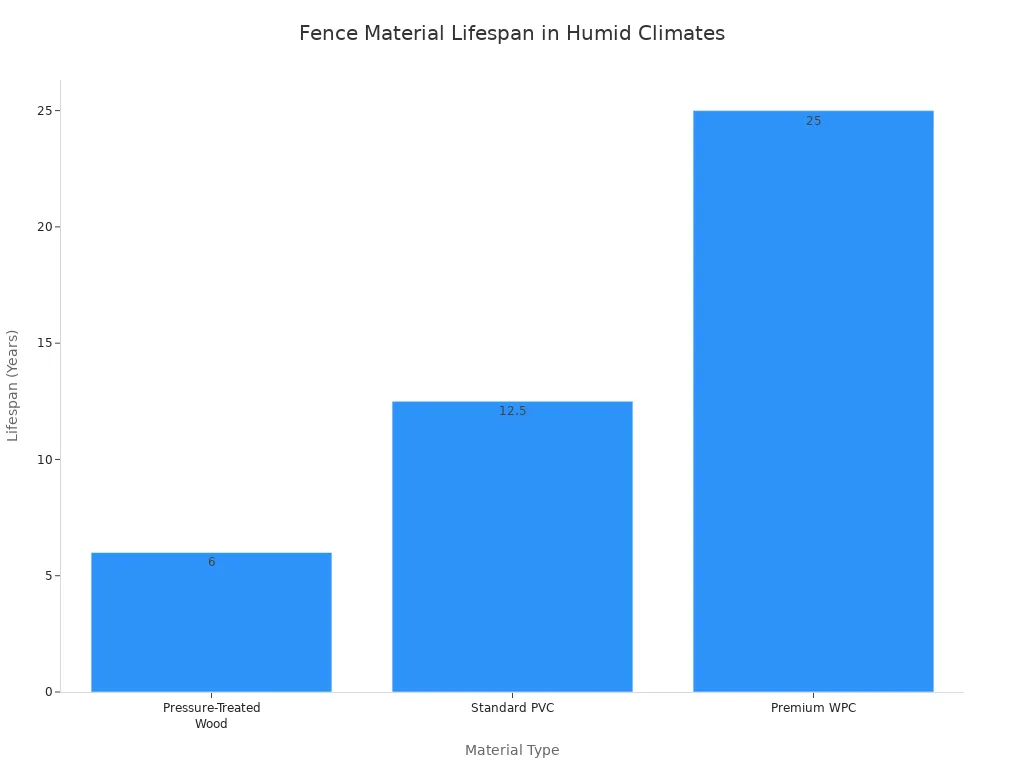
A 5-year Florida coastal study demonstrated WPC maintained 98.7% mold-free surfaces. This significantly outperformed cedar wood, which only achieved 34% mold-free surfaces under similar conditions. The Grand Cayman Resort project further showcased WPC's durability. After 8 years in 85% average humidity, it exhibited only 0.8% linear expansion. It also showed less than 0.1% surface mold coverage. It retained 94% of its original flexural strength.
For tropical and subtropical regions with over 70% relative humidity, ASTM recommends:
- Coastal areas: Salt-resistant WPC formulations with 304-grade stainless steel fasteners.
- Rainforest climates: WPC with enhanced hydrophobic agents to reduce surface moisture retention to under 12 minutes.
- Monsoon regions: Impact-modified WPC with a flexural modulus exceeding 2,500 MPa (ASTM D790).
These specific formulations and installation practices ensure your WPC fence performs optimally even in the most challenging climates.
Maximizing the Longevity of Your WPC Garden Fence

You can significantly extend the life of your WPC garden fence with proactive care. Simple steps ensure your investment continues to look great and perform well for decades.
Simple Cleaning and Routine Maintenance
Regular cleaning is essential for maintaining your WPC fence's appearance and preventing issues. You should clean your fence seasonally, ideally two to three times a year. Consider cleaning after heavy storms to remove mud splatter. More frequent cleaning may be necessary if your fence is near dusty roads or dense foliage. This routine prevents mold, mildew, and dirt buildup, which can negatively impact both its look and its lifespan.
For routine cleaning, gather a soft-bristle brush or sponge, a garden hose (use a low-pressure setting), mild soap or a composite deck cleaner, and warm water. First, rinse the fence surface. Then, apply soapy water, using either mild soap or a composite cleaner. Gently scrub along the grain of the material. Finally, rinse the fence thoroughly.
You can address specific issues with targeted cleaning methods:
- Dirt and Mud: Sweep away loose debris with a broom. Then, scrub with a soft-bristled brush, soap, and water. Apply pressure against the grain for effective cleaning.
- Mold, Mildew, and Algae: Mix one part white vinegar with three parts water, or use commercial mold removers safe for composite materials. Apply the solution, let it sit for 10-15 minutes, then gently scrub and rinse with water.
- Grease or Oil: Use a degreasing agent, such as Dawn dish soap. Scrub lightly and rinse thoroughly.
- Rust Stains: Apply a cleaner containing oxalic acid. Gently scrub and rinse completely.
- Hard Water Spots: Use a 50/50 vinegar-water mix. Wipe the fence with a microfiber cloth after rinsing.
You must avoid certain practices to protect your WPC fence. Do not use high-pressure washing, as excessive force can damage the outer shell. Avoid bleach-based cleaners; harsh chemicals can discolor or weaken the composite material. Painting composite fences is unnecessary and can void the manufacturer's warranty. Also, do not let debris sit on the fence. Wet leaves, mud, or algae buildup can cause staining if you do not clean them promptly.
Prompt Repair of Minor Damage
Addressing minor damage quickly prevents it from worsening and preserves your fence's appearance. You can often repair small scratches, dents, or surface damage effectively.
For minor scratches or scuff marks, gently sand the affected area. Use fine-grit sandpaper in a circular motion. Afterward, wipe the area clean with a damp cloth. This method helps blend the scratch into the surrounding material.
If you encounter deeper scratches or dents, you can use a heat gun. Carefully apply heat to soften the WPC material. Once the material becomes pliable, gently push the dent back into shape with a flat tool. Allow the panel to cool and harden completely.
For small holes or more extensive damage, you can fill and patch them with suitable filler materials. After filling, sand and refinish the surface to blend it seamlessly with the rest of the fence. Regular cleaning and polishing can also help restore the original luster of panels with minor surface damage. If you face extensive damage or finish issues, repainting or refinishing may be necessary. Ensure careful color matching for a seamless repair.
Ensuring Proper Drainage and Ventilation
Proper drainage and ventilation are crucial for the long-term health of your WPC fence. You must prevent water from pooling around the base of your fence posts or panels. Stagnant water can lead to moisture buildup, even with WPC's water-resistant properties. Ensure the ground slopes away from the fence line. This directs rainwater away from the structure.
Good air circulation around and through your fence panels also helps. It prevents moisture from lingering on surfaces. Trim any dense vegetation, such as bushes or vines, that grow too close to the fence. This allows air to flow freely. Clear away leaves, dirt, and other debris that can accumulate at the fence base. These materials can trap moisture and create an environment conducive to mold or mildew growth, even on WPC. By ensuring proper drainage and ventilation, you help your fence dry quickly after rain and maintain its integrity over time.
A WPC garden fence offers exceptional long-term value and performance. You can achieve decades of reliable service. This requires informed material choices, expert installation, and consistent care. Investing in a high-quality WPC garden fence and adhering to maintenance guidelines ensures lasting beauty and functionality.
FAQ
How often do I need to clean my WPC fence?
You should clean your WPC fence seasonally, two to three times a year. This prevents dirt and mold buildup, maintaining its appearance.
Does WPC fade in the sun?
Manufacturers integrate UV stabilizers into WPC. These prevent color fading, retaining much of the original hue for many years.
Can WPC fences resist pests like termites?
Yes, the plastic content in WPC creates a barrier. Termites and other wood-boring insects find WPC unappealing, protecting your fence.