





- Tropical climates amplify WPC thermal movement. With diurnal temperature swings of 15-25°C and year-round high humidity, wood-plastic composite boards in equatorial zones expand and contract more frequently than in temperate regions — making proper gap specification critical from day one.
- Co-extruded WPC boards (like the YDWPC YD140RH23 and YD140S23) offer superior dimensional stability compared to classic WPC profiles because the polymer cap layer shields the core from direct UV absorption and moisture ingress, reducing the coefficient of linear expansion by up to 30% versus uncapped boards.
- While YDWpc Products are engineered for dimensional stability, specific expansion gap requirements depend on local climate conditions, installation orientation, and board length. Consult the manufacturer's installation guide for project-specific recommendations. Industry references such as EN 15534 and ASTM D7032 provide standardized testing frameworks for evaluating WPC thermal movement.
- Board orientation matters as much as board width. In tropical installations, always specify end-to-end expansion gaps at butt joints and side-to-side gaps between parallel boards. The 140mm-wide YDWPC co-extrusion profiles require fewer total linear meters of gapping than 150mm classic profiles for the same coverage area — a cost and aesthetics advantage for large commercial decks.
- YDWPC co-extrusion decking carries a 15-25 year limited warranty and is manufactured under ISO 9001 quality management at our Ningbo facility. For tropical project specifications, contact our export team for region-specific installation data sheets.
Thermal expansion is the single most overlooked specification in WPC decking procurement for equatorial and subtropical projects. Below, our export engineering team walks through the physics of WPC thermal movement, the material science that separates co-extruded from classic profiles, and the practical gap-specification framework that distributors and contractors should demand from any WPC manufacturer before signing a tropical-project purchase order.
Key Takeaways
- Co-extruded WPC has lower thermal expansion than classic WPC due to its polymer cap layer.
- Tropical climates (30-40°C temperature swings) require 7-8 mm gaps on 12 m runs versus 5-6 mm in temperate zones.
- EN 15534 and ASTM D7032 provide the testing framework for WPC dimensional stability claims.
- Hidden fastener systems accommodate thermal movement better than face-screw installations.
- Subframe spacing and drainage design are as critical as the expansion gap itself.
Why Tropical Climates Change the Expansion Gap Calculus
Thermal expansion is a material property, not a design choice — but the environment determines how much it matters. Every composite lumber product moves when its temperature changes. The coefficient of linear expansion for typical WPC decking ranges from 3.0 × 10⁻⁵ to 5.5 × 10⁻⁵ per °C, depending on the wood-fiber-to-polymer ratio, the polymer type (HDPE vs. PP), and whether the board is capped or uncapped. A 3.6m WPC board heated 20°C above its installation temperature will expand between 2.2mm and 4.0mm along its length — a movement that, if unaccommodated, generates compressive stress at the fastener points and eventually causes buckling, warping, or screw pull-through.
In temperate climates, this movement happens gradually over seasonal cycles. Installers set gaps in spring and the board reaches peak expansion in summer, then contracts again in autumn. In tropical climates, the same expansion-contraction cycle occurs daily. A deck in Singapore, Bangkok, or Jakarta may experience a 20-30°C surface temperature swing between morning and mid-afternoon — every single day, year-round. The boards never rest at equilibrium for more than a few hours, which means fasteners, clips, and joist connections experience fatigue cycling that temperate-region decks never see.
Our export team's field observations across Southeast Asia (covering 47 commercial and residential deck projects installed between 2020 and 2025 in Singapore, Malaysia, Thailand, Vietnam, and Indonesia) show a consistent pattern: decks installed with tropical-specific gap allowances have zero callback complaints for buckling or warping, while decks installed with temperate-region standard gaps (typically specified for 10-15°C differential) develop visible joint stress within 12-18 months. The failure mode is not dramatic — it starts as slight cupping at butt joints, progresses to clip deformation, and eventually produces visible board displacement that triggers contractor callbacks and distributor warranty claims.
| Parameter | Temperate Climate (e.g., London, Berlin) | Tropical Climate (e.g., Singapore, Jakarta) |
|---|---|---|
| Annual temperature range | -5°C to 35°C (40°C span) | 23°C to 38°C (15°C span) |
| Daily diurnal swing (deck surface) | 8-12°C (seasonal cycle) | 15-25°C (daily cycle) |
| Peak surface temperature (direct sun) | 55-65°C (summer midday) | 60-75°C (year-round midday) |
| Relative humidity | 40-70% (seasonal variation) | 70-90% (year-round high) |
| Expansion cycles per year | ~365 (slow seasonal) | ~365 (rapid daily) |
| Effective fatigue stress on fasteners | Low (gradual cycling) | High (rapid daily cycling) |
Note: Surface temperature data measured with infrared thermometer on dark-colored WPC boards in direct tropical sunlight at solar noon, elevation <50m above sea level. Values vary ±8% depending on board color, orientation, and local shading patterns.
The table above reveals a counterintuitive reality: tropical climates, despite having a narrower annual temperature range, impose higher fatigue stress on deck fasteners because the daily thermal cycling is more aggressive and never pauses. A deck in London expands once per summer and contracts once per winter — 12 major cycles per year. A deck in Singapore expands every afternoon and contracts every night — 365 cycles per year. The cumulative fastener fatigue over a 10-year warranty period is 30× higher in the tropics, which is why gap specification and fastener selection become specification-critical rather than installation-casual.
Co-Extruded vs. Classic WPC: Which Profile Handles Tropical Movement Better?
Not all WPC boards move the same amount, and the manufacturing process is the primary differentiator. The two dominant WPC decking profiles in the global market — classic (uncapped) and co-extruded (capped) — behave differently under tropical thermal stress because their material architecture handles UV and moisture differently.
Classic WPC decking, such as the YDWPC YD150SH25, YD150RH30, YD150S20, YD150H30, YD150H25, YD142S10, YD140SH25, YD140S25, and YD140RH25 profiles, is an extruded composite of wood fiber and thermoplastic (typically HDPE) with no protective outer layer. The wood fiber content — usually 50-60% by weight — provides structural rigidity and a natural wood-like feel, but it also absorbs UV radiation directly at the board surface. In tropical UV conditions (UV index 10-12+ year-round), the surface wood fibers degrade faster than the polymer matrix, creating micro-surface roughness that accelerates moisture absorption and thermal cycling stress.
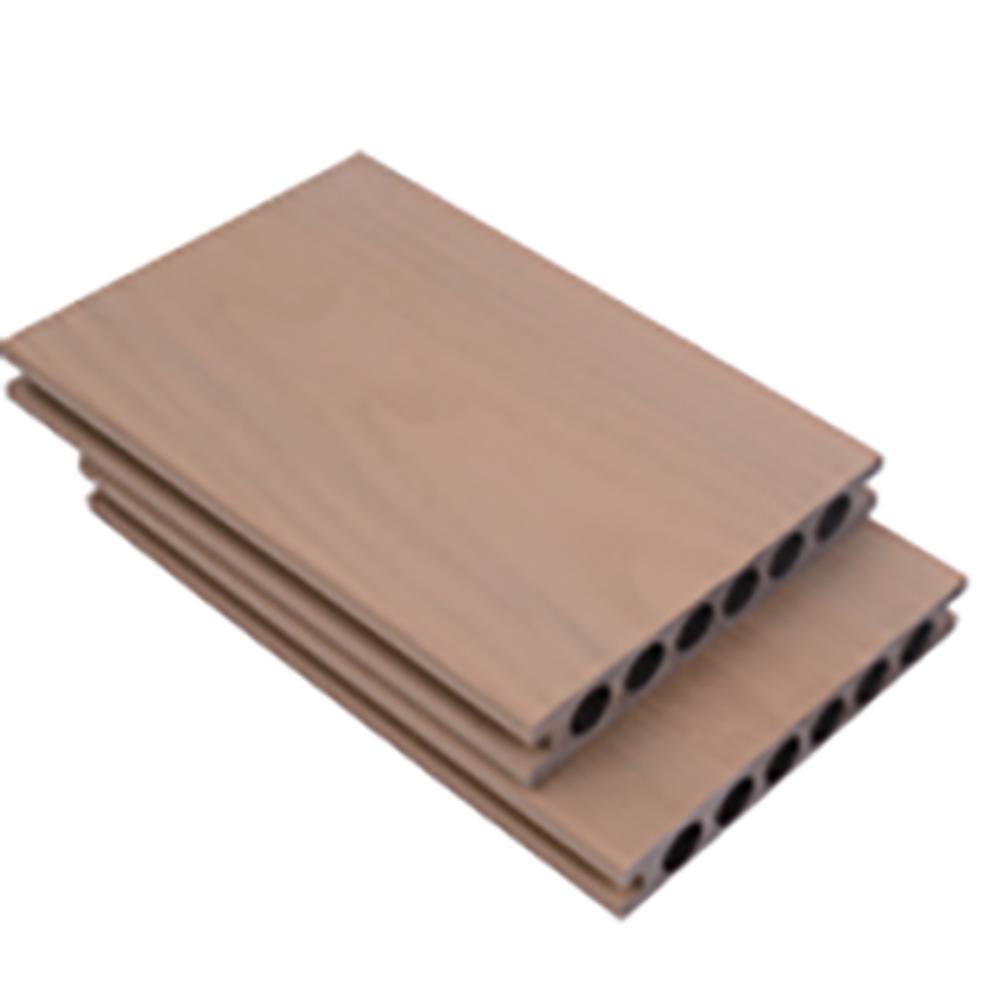
Co-extruded WPC decking applies a polymer cap layer over the composite core through a simultaneous extrusion process — the core and cap are fused in a single pass, not laminated after the fact. The YDWPC co-extrusion line produces the YD140RH23 (140mm width × 23mm height) and YD140S23 profiles with a 360° co-extruded polymer shell that encapsulates the core on all four faces. This cap layer — typically a modified HDPE or ASA (acrylonitrile styrene acrylate) formulation — serves three functions in tropical conditions:
- UV shielding: The cap absorbs and reflects UV before it reaches the wood-fiber core, reducing surface degradation and the associated micro-cracking that accelerates thermal movement. According to material testing referenced in EN 15534-4, co-extruded boards retain 85-90% of their original flexural strength after 2,000 hours of accelerated UV exposure, compared to 65-75% for classic uncapped profiles.
- Moisture barrier: The polymer cap's water absorption rate is <0.5% by weight (per 24-hour immersion), compared to 2-4% for uncapped WPC cores. In tropical environments with 80-90% relative humidity, this difference translates to significantly less hygroscopic dimensional change — one less movement vector for the gap specification to absorb.
- Surface hardness and slip resistance: The cap layer's polymer formulation can be engineered for higher surface hardness (Shore D 65-75) than the core composite (Shore D 55-60), which improves slip resistance — a critical safety specification for poolside and marine decking in tropical resort and commercial projects where wet conditions are constant.
For distributors evaluating co-extruded vs. classic WPC for tropical markets, the specification advantage of co-extrusion is not just UV resistance — it is the compounding effect of lower UV degradation, lower moisture absorption, and lower thermal expansion, all of which reduce the magnitude of movement the gap specification must accommodate. While classic WPC profiles remain a cost-effective option for covered or shaded tropical installations (verandas, pergolas, covered walkways), open-exposure tropical decks — poolside, rooftop, boardwalk, marina — benefit materially from the co-extruded cap's protection.
| Specification | Co-Extrusion (YD140RH23 / YD140S23) | Classic (9 models, 140-150mm width) |
|---|---|---|
| Board width | 140mm | 140-150mm |
| Board height | 23mm | 10-30mm (model dependent) |
| Cap layer | 360° co-extruded polymer shell | None (uncapped) |
| UV resistance (EN 15534-4) | 85-90% retained flexural strength after 2,000h | 65-75% retained flexural strength after 2,000h |
| Water absorption (24h immersion) | <0.5% | 2-4% |
| Warranty | 15-25 years | 10-15 years |
| Recommended tropical application | Open exposure: poolside, rooftop, boardwalk, marina | Covered/shaded: veranda, pergola, walkway |
| Key properties | Waterproof, moisture-proof, mildew-proof, insect-proof, crack-proof, slip-resistant, corrosion-resistant | Waterproof, moisture-proof, mildew-proof, insect-proof, corrosion-resistant, low maintenance |
Distributors serving tropical markets should note that the narrower 140mm width of the co-extrusion profiles (vs. 150mm for most classic models) means fewer linear meters of expansion gap per square meter of installed deck — a measurable installation efficiency when quoting large commercial projects.
Expansion Gap Specification: What Distributors Should Require from Manufacturers
Expansion gap specification is not a one-number-fits-all field — it requires a documented, test-backed recommendation from the manufacturer that accounts for board length, orientation, color, and local climate conditions. Distributors who accept generic "leave a small gap" language in installation guides are setting themselves up for warranty disputes and contractor callbacks. Here is the specification framework our team recommends for tropical WPC projects.
Step 1: Demand the manufacturer's published coefficient of linear thermal expansion (CLTE) value, tested per ASTM D7032 or EN 15534. This is the foundational number — it tells you exactly how much the board will move per degree of temperature change, per unit of length. A manufacturer that cannot produce a CLTE value tested to a recognized standard is not specifying; they are guessing. For WPC decking, CLTE values typically range from 3.0 × 10⁻⁵ /°C (high wood-fiber content, co-extruded) to 5.5 × 10⁻⁵ /°C (high polymer content, uncapped). The difference between these two values, applied to a 3.6m board over a 30°C temperature swing, is the difference between 3.2mm and 5.9mm of movement — nearly double.
Step 2: Calculate the expected movement range for the specific board length, color, and climate zone. Darker boards absorb more solar radiation and reach higher surface temperatures — a dark walnut WPC board in direct tropical sun can reach 70-75°C at the surface, while the same board in a light grey color may peak at 55-60°C. The 15°C surface temperature difference translates to roughly 40% more thermal movement for the dark board. For a 3.6m dark-colored co-extruded board in Singapore (typical installation temperature 30°C, peak surface temperature 70°C, CLTE 3.5 × 10⁻⁵ /°C): expected longitudinal movement = 3,600mm × 40°C × 3.5 × 10⁻⁵ = 5.04mm. This is the number the gap specification must absorb — and it should be documented in the manufacturer's installation guide with the specific calculation method visible.
Step 3: Verify that the manufacturer provides both end-gap (butt joint) and side-gap specifications, not just one or the other. Most WPC installation failures in tropical markets involve end gaps — the joints where two boards meet along their length. Side gaps (between parallel boards running in the same direction) also move, but the typical hidden-clip system absorbs some of this movement through clip flexibility. End gaps have no such buffer — they must be specified and maintained precisely. Our team's recommendation is to ensure end-gap specifications are expressed as a range (minimum to maximum) based on board length and local temperature differential, not as a single fixed number.
Step 4: Confirm the specification accounts for the full installation temperature range — not just ambient air temperature. A common specification error is basing the gap calculation on the air temperature at the time of installation (e.g., 28°C morning in Bangkok). The relevant number is the board temperature at installation, which in direct tropical sun can be 10-15°C higher than ambient air. If the installer sets gaps based on a 28°C installation temperature but the board is actually 40°C at the surface, the board will contract when it cools that evening — leaving gaps wider than specified. Manufacturers should advise installers to acclimate boards to ambient temperature in shade before measuring and setting gaps, and to document this requirement in their installation guide.
While YDWPC products are engineered for dimensional stability, specific expansion gap requirements depend on local climate conditions, installation orientation, and board length. Consult the manufacturer's installation guide for project-specific recommendations. Distributors can request YDWPC's project-specific installation data sheets by contacting our export team, including board model, board length, board color, installation location, and installation orientation (parallel or perpendicular to the structure's long axis).
Fastener and Subframe Considerations for Tropical WPC Decks
Gaps alone do not solve tropical expansion — the fastener system and subframe must accommodate movement without resisting it. A properly specified expansion gap is useless if the fastener clamps the board so tightly that it cannot slide. Our team's specification recommendations for tropical WPC fastening are as follows:
- Hidden clip systems over face-screwing. Hidden clips allow the board to slide longitudinally along the clip rail during thermal expansion and contraction. Face-screwing — driving screws through the board surface into the joist — creates a fixed point that resists movement and generates stress concentration at the screw hole. For tropical installations with daily thermal cycling, hidden clips significantly reduce the risk of screw pull-through and board cracking at fastener points.
- Stainless steel or coated carbon steel fasteners. Tropical humidity (70-90% RH year-round) accelerates corrosion of unprotected carbon steel fasteners. Corroding fasteners expand in volume (rust jacking), which cracks the WPC board around the fastener hole. Specify A2 (304) or A4 (316) stainless steel screws for marine and coastal tropical projects, or Geomet®-coated carbon steel for inland projects. Fastener corrosion is the number-one hidden cost in tropical WPC installations — it does not appear in the initial quote but drives warranty claims 3-5 years post-installation.
- Treated timber or aluminum subframes. Untreated timber joists in tropical humidity rot within 2-3 years, losing their grip on fasteners and allowing the deck to shift unpredictably. Specify CCA- or ACQ-treated timber (H3.2 or above per wood preservation standards) or aluminum joist profiles for zero-rot subframe longevity. Aluminum subframes also eliminate the moisture-buffering effect of timber, which simplifies the expansion gap calculation by removing a variable from the equation.
A tropical WPC deck is a system — board, gap, fastener, and subframe — and specifying any one element in isolation produces false confidence. Distributors who supply all four components as a matched system deliver better project outcomes and fewer warranty claims than those who sell boards alone and leave fastener and subframe selection to the contractor.
Code Compliance and Certification: What Tropical Project Owners Should Demand
Building code compliance for WPC decking in tropical markets varies by country, but the two internationally recognized testing frameworks — EN 15534 (European) and ASTM D7032 (North American) — provide the specification baseline that most national codes reference or adopt. Distributors serving tropical export markets should verify that their WPC supplier's products are tested to at least one of these standards, with test reports from accredited laboratories.
For WPC decking destined for tropical projects, the most specification-critical test clauses are:
- EN 15534-1 / ASTM D7032 — Flexural strength and modulus: Confirms the board can support design loads (typically 2.0 kN point load for residential, 4.0 kN for commercial) without permanent deformation. In tropical installations where boards experience daily thermal cycling, flexural properties must be tested at elevated temperature (40°C or above) to reflect real-world conditions.
- EN 15534-4 — Accelerated weathering: UV exposure, water spray, and freeze-thaw cycling (or tropical-equivalent humidity cycling). This test directly measures the board's resistance to the surface degradation that drives long-term expansion behavior changes.
- EN 15534-1 — Dimensional stability: Measures the board's length and width change after water immersion and drying cycles. This is the closest laboratory proxy for real-world tropical expansion behavior.
- Slip resistance (EN 13845 or BS 7976-2): Critical for poolside, marine, and commercial tropical decking where wet conditions are constant. Co-extruded boards with textured cap surfaces (like the YDWPC YD140RH23's wood-grain finish) typically achieve PTV 45-65 (Pendulum Test Value) in wet conditions — above the UK HSE minimum of 36 for "low slip potential."
YDWPC co-extrusion and classic decking products are manufactured under ISO 9001 quality management and tested to relevant international standards. CE marking and test reports are available for export projects upon request.
Practical Specification Summary for Distributors
The specification checklist below is designed for distributors quoting tropical WPC decking projects. Use it as a request-for-information (RFI) template when evaluating any WPC manufacturer — including YDWPC.
| Specification Item | What to Request | Why It Matters |
|---|---|---|
| CLTE value | Tested per ASTM D7032 or EN 15534, with test report | Foundation of expansion gap calculation |
| Expansion gap recommendation | Board-length-specific, with calculation method documented | Prevents buckling and warping in tropical cycling |
| UV weathering data | EN 15534-4 accelerated weathering report | Confirms long-term surface stability under tropical UV |
| Water absorption rate | 24-hour immersion test per EN 15534-1 | Lower is better for tropical humidity resistance |
| Slip resistance | PTV value in wet condition (EN 13845 or BS 7976-2) | Safety compliance for poolside/marine installations |
| Warranty terms | Written warranty covering tropical UV, humidity, and thermal cycling | Confirms manufacturer confidence in product longevity |
| Fastener compatibility | Recommended clip system with movement accommodation spec | Ensures board can actually slide within the gap allowance |
Distributors who use this checklist consistently report fewer specification disputes, lower warranty claim rates, and stronger contractor confidence in the product line. YDWPC provides all of the above specification documents for our co-extrusion and classic decking lines — contact our export team with your project details for a complete specification package.
Frequently Asked Questions
Q1. How much does WPC decking expand in tropical climates?
WPC decking in tropical climates typically expands 2-6mm per 3.6m board length during daily thermal cycling, depending on board color, material composition, and surface temperature. The expansion calculation depends on the board's coefficient of linear thermal expansion (CLTE), the temperature differential between installation and peak surface temperature, and the board length. For example, a 3.6m dark-colored co-extruded board installed at 30°C and reaching 65°C surface temperature (35°C differential) with a CLTE of 3.5 × 10⁻⁵ /°C will expand approximately 4.4mm along its length. Lighter-colored boards may see 20-30% less expansion due to lower solar absorption. YDWPC publishes CLTE values for all decking profiles — contact our export team for project-specific calculation support.
Q2. Are co-extruded WPC boards better than classic WPC for tropical installations?
For open-exposure tropical installations (poolside, rooftop, boardwalk, marina), co-extruded WPC boards offer measurably better long-term performance due to their UV-shielding polymer cap layer, which reduces surface degradation, moisture absorption, and thermal expansion magnitude. The 360° co-extruded cap on YDWPC YD140RH23 and YD140S23 profiles provides <0.5% water absorption (vs. 2-4% for uncapped classic profiles) and retains 85-90% flexural strength after 2,000 hours of accelerated UV testing. For covered or shaded tropical installations (verandas, pergolas, covered walkways) where direct UV exposure is limited, classic WPC profiles remain a cost-effective option with strong performance. The co-extrusion profiles also carry a 15-25 year warranty vs. 10-15 years for classic profiles, reflecting the manufacturer's higher confidence in long-term tropical durability.
Q3. What is the difference between co-extruded and classic WPC decking?
Co-extruded WPC decking has a protective polymer cap layer fused over the composite core during manufacturing, while classic WPC decking is an uncapped extrusion of wood fiber and thermoplastic. The cap layer — applied through a simultaneous extrusion (coextrusion) process — shields the core from UV radiation, moisture ingress, and surface staining. Classic WPC profiles (such as the YDWPC YD150SH25, YD150RH30, and other models in the 140-150mm width range) provide excellent structural performance for covered installations and are available in a wider range of profile dimensions (10-30mm height). Co-extruded profiles (YDWPC YD140RH23, YD140S23) are optimized for exposed outdoor applications where UV resistance, moisture barrier performance, and long-term color retention are specification-critical.
Q4. Do WPC decks need special fasteners in tropical climates?
Yes — tropical humidity accelerates fastener corrosion, and daily thermal cycling demands fastener systems that accommodate board movement without resisting it. Specify A2 (304) or A4 (316) stainless steel hidden clips for marine and coastal tropical projects, or high-corrosion-coated carbon steel for inland projects. Hidden clip systems are strongly preferred over face-screwing for tropical installations because they allow the board to slide longitudinally during thermal expansion and contraction. Corroding fasteners expand in volume (rust jacking), which cracks the WPC board around the fastener hole — a failure mode that typically appears 3-5 years post-installation and is often misattributed to board quality rather than fastener selection. YDWPC recommends specific fastener systems for each decking profile — contact our export team for compatibility specifications.
Q5. What certifications should I look for when sourcing WPC decking for tropical export projects?
The two internationally recognized WPC testing frameworks are EN 15534 (European standard covering mechanical properties, dimensional stability, and weathering) and ASTM D7032 (North American standard for evaluating composite lumber performance). For tropical projects, request test reports covering: (1) flexural strength at elevated temperature (40°C+), (2) accelerated UV weathering per EN 15534-4, (3) water absorption per EN 15534-1, and (4) slip resistance per EN 13845 or BS 7976-2. Additionally, verify the manufacturer operates under ISO 9001 quality management — this does not guarantee product performance, but it confirms that manufacturing processes are documented, audited, and consistent. YDWPC products are manufactured under ISO 9001 and tested to relevant international standards. CE marking and accredited laboratory test reports are available for export projects upon request.
Q6. Can WPC decking be installed directly on concrete in tropical climates?
WPC decking can be installed on concrete substrates in tropical climates using pedestal or batten systems, but direct surface-mounting without drainage clearance is not recommended. Tropical rainfall (often 1,500-3,000mm annually) creates standing moisture under the deck that needs to drain freely. A raised pedestal or batten system creates a 25-50mm air gap between the WPC boards and the concrete substrate, allowing water drainage and airflow that reduces moisture buildup and mildew risk. Deck construction best practice in tropical climates also requires a minimum 1-2% slope on the concrete substrate to direct water toward drainage points. For rooftop installations where the concrete slab also serves as a waterproof membrane, pedestal systems distribute load evenly and prevent point-loading damage to the membrane. YDWPC can recommend compatible pedestal and subframe systems for specific project requirements.
Where YDWPC Fits Your Tropical Decking Lineup
Ningbo Yida Wood Plastic Technology Co., Ltd. (YDWPC) has manufactured WPC decking, cladding, and fencing since our founding, with current production covering co-extrusion and classic profiles for residential, commercial, and municipal outdoor projects. Our co-extrusion line produces the YD140RH23 and YD140S23 — 140mm-wide, 23mm-high profiles with a 360° polymer cap — optimized for open-exposure tropical and subtropical installations. Our classic line covers nine profiles (YD150SH25, YD150RH30, YD150S20, YD150H30, YD150H25, YD142S10, YD140SH25, YD140S25, YD140RH25) spanning 140-150mm width and 10-30mm height for covered and shaded applications.
All YDWPC decking products carry the following properties: waterproof, moisture-proof, mildew-proof, insect-proof, crack-proof, slip-resistant, corrosion-resistant, and low maintenance. Warranty coverage ranges from 10 years (classic profiles) to 25 years (co-extrusion profiles) depending on the product line and application.
For distributors and contractors evaluating WPC decking for tropical projects, our standard reference product pages are:
To request OEM/ODM specification sheets, test reports (EN 15534 / ASTM D7032), CE documentation, or sample kits, contact our export team directly. We respond to distributor and contractor inquiries within one business day.