





Why should you choose composite wood over timber for your decking and fencing needs?

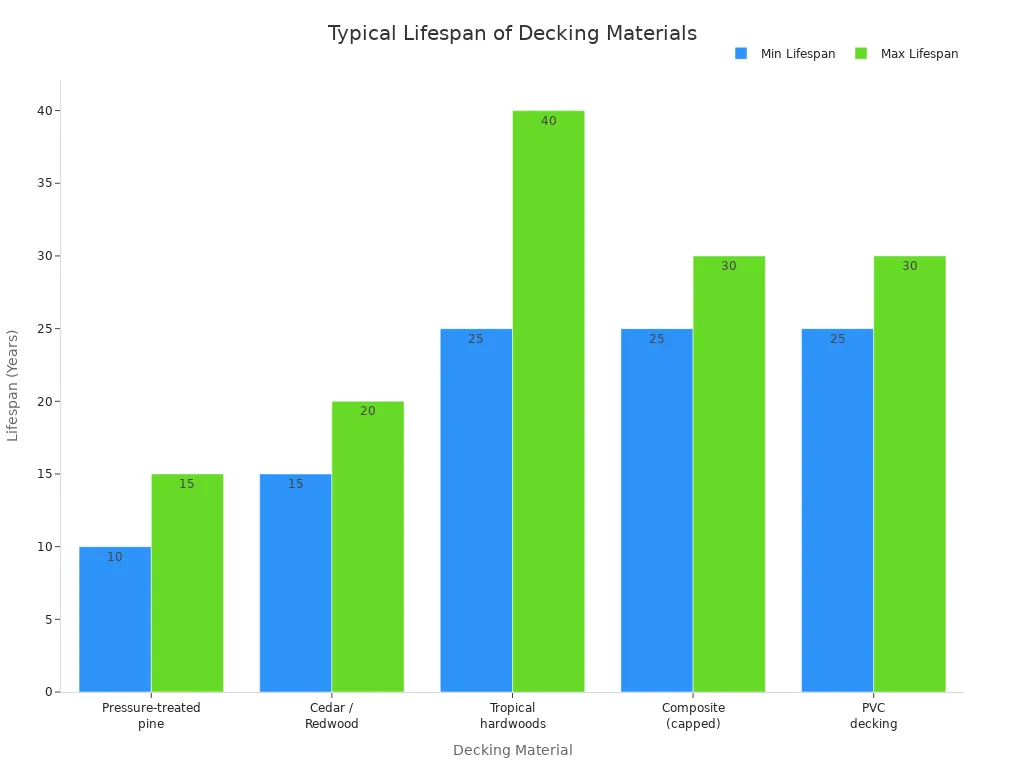
Composite wood offers unparalleled durability, minimal maintenance, and superior aesthetics for decking and fencing. It provides a long-term, high-performance outdoor solution, a definitive upgrade from traditional timber. Composite decking, for example, lasts 25-50 years. Choose composite for lasting beauty and functionality, including your Wpc Garden Fence, in your home's exterior.
Key Takeaways
- Composite wood lasts longer than timber. It resists rot, pests, and warping. This means your deck or fence stays strong for many years.
- Composite wood needs little care. You do not need to paint or stain it. Just clean it with soap and water. This saves you time and money.
- Composite wood is good for the Earth. It uses recycled materials. This helps the environment. It is a smart choice for your home.
Unrivaled Durability and Weather Resistance
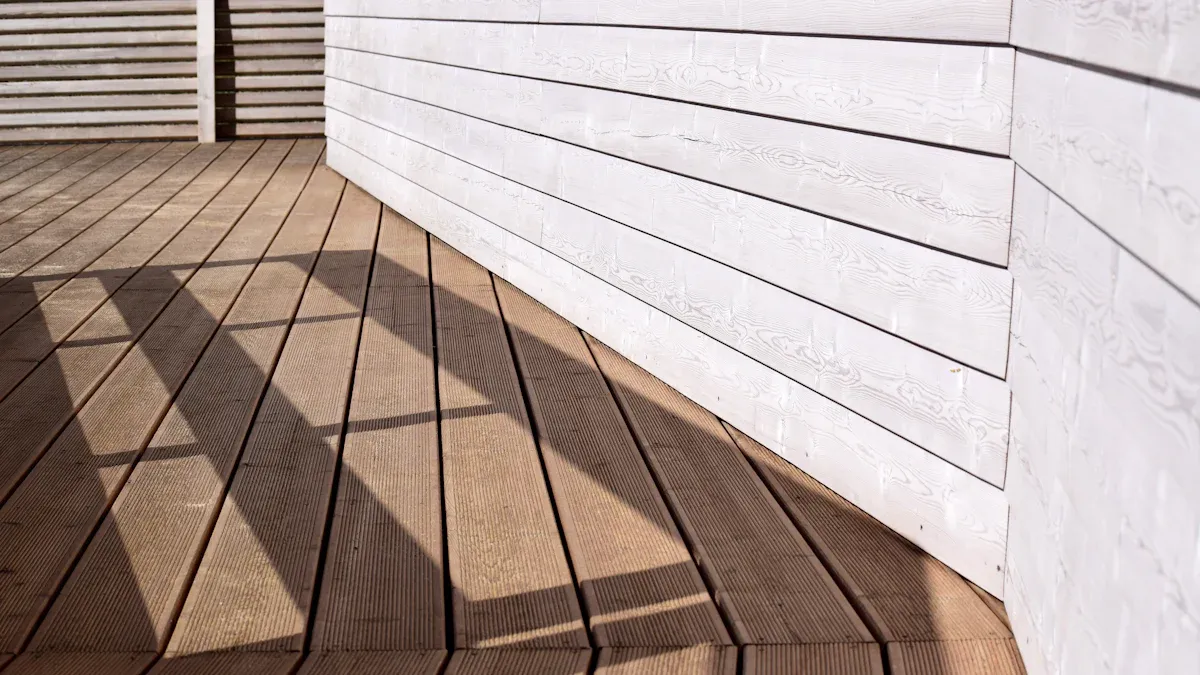
Composite wood offers exceptional resistance to environmental threats. It effectively withstands rot, decay, and pests. This material provides a robust solution for outdoor applications.
Withstanding Rot, Decay, and Pests
Manufacturers create composite wood from recycled wood fibers, plastic, and high-density polyethylene (HDPE). This composition makes it inherently resistant to moisture. Composite decking excels in damp conditions. It does not absorb moisture. This prevents swelling, warping, or rotting when exposed to rain, snow, or high humidity. Traditional wood decks are sensitive to moisture. They can swell, warp, or rot in wet conditions. Even moisture-resistant woods like cedar and redwood require regular maintenance to preserve their integrity against moisture.
Some brands, like TimberTech, cap their decking with a high-performance polymer. This polymer locks out moisture. MoistureShield decking features Solid Core technology. This technology encapsulates wood fibers in polyethylene plastic. It protects against moisture, rot, and insects. MoistureShield decking is highly resistant to moisture, rot, insects, and other elements. It offers a 50-year structural warranty. This demonstrates its long-term durability.
Composite wood also incorporates specific treatments to deter pests. Borate wood preservative protects wood, including composite materials, from termite attacks. It eliminates wood as a food source. Manufacturers apply it during the production process. Other treatments include Copper Azole, used for various wood products, and Triadimefon, an EPA-approved fungicide for preserving wood-based composite products. Bora-Care Wood Treatment provides prevention and control against termites, carpenter ants, powderpost beetles, and decay fungi. It applies to all cellulosic materials, including wood composite structural components. This comprehensive protection ensures the longevity of a wpc garden fence and other outdoor structures. POLYWOOD® furniture, a type of composite wood product, comes with a twenty-year warranty for residential use. This warranty covers the product against material defects, splintering, cracking, chipping, peeling, rotting, and structural damage caused by insect infestation under normal use and service conditions.
Eliminating Warping, Cracking, and Splinters
Composite wood significantly reduces common problems like warping, cracking, and splinters. It exhibits superior dimensional stability compared to natural timber. Composite decking generally expands and contracts less than natural wood. The rate can vary by material. Pure PVC decking shows more expansion. Mineral-based composite decking, such as Deckorators, shows virtually no expansion or contraction. This occurs even under significant temperature fluctuations. Composite decking boards typically expand and contract at a rate of 0.1% to 0.3% of their length. Natural timber decking tends to expand and contract significantly. This is due to moisture absorption and release. It can lead to issues like warping and splitting. Composite decking is engineered to resist moisture. This results in considerably less noticeable expansion and contraction. It also improves dimensional stability.
Industry standards and tests confirm composite wood's resistance to these issues. ANSI A135.6 Engineered Wood Siding Standards include dimensional and physical property tests. These tests measure precise specifications such as length, width, thickness, squareness, and straightness. Additional tests assess bending strength, stiffness, moisture content, linear expansion, and thickness swell. All these factors relate to resistance against warping and cracking. Proper installation, as specified by ANSI A135.6-compliant guidelines, includes precise gap allowances. These gaps accommodate seasonal changes and protect against moisture. This is crucial for preventing issues like warping and maintaining warranty coverage.
Solid Wpc Decking's composition contributes to its resistance to cracking. The plastic component offers excellent flexibility and elasticity. This allows the decking to absorb and distribute stress from external forces. It bends slightly without breaking. The wood fibers are treated to resist moisture absorption. The plastic coating acts as a barrier. This significantly reduces the expansion and contraction caused by moisture. This expansion typically leads to cracking in traditional wood. Solid WPC Decking handles temperature fluctuations better than traditional wood. Its plastic component has alower coefficient of thermal expansion. This means it expands and contracts less with temperature changes. This reduces stress and minimizes the risk of cracking. WPC decking is highly resistant to moisture. It prevents the rotting, warping, and decay seen in traditional wood when exposed to water. This maintains structural integrity and prevents swelling and shrinking that lead to cracking.
Superior Fade and Stain Protection
Composite wood surfaces offer superior protection against fading and stains. Their non-porous nature creates a strong barrier against liquids. This is unlike traditional porous wood. This characteristic makes them ideal for outdoor areas. Maintaining a clean appearance is crucial in these spaces. Composite wood surfaces are highly resistant to various staining agents, spills, and discoloration. This ensures the material retains its aesthetic appeal over time. This feature is particularly beneficial for a wpc garden fence, where exposure to elements and potential spills is common.
Significant Savings Through Low Maintenance
Composite wood offers substantial financial benefits through its minimal maintenance requirements. This material significantly reduces the time and money homeowners spend on upkeep.
No Need for Painting, Staining, or Sealing
Composite wood eliminates the need for regular painting, staining, or sealing. Traditional timber decks and fences demand significant annual upkeep. Homeowners must stain and seal them to prevent warping, bowing, or rotting. Composite decks, in contrast, are far more durable and resistant to weather. They require minimal maintenance over their 30 to 40-year lifespan. This difference translates into considerable savings.
| Decking Type | Annual Maintenance Cost (Materials) | Annual Maintenance Cost (Labor per sq. meter) |
|---|---|---|
| Timber Decking (30 sq. meters) | $225-300 | $15-25 |
| Composite Decking | $0-50 (for occasional cleaning) | N/A |
This table illustrates the stark contrast in annual maintenance costs. Composite decking requires only occasional cleaning, incurring minimal material costs and no labor for staining or sealing.
Effortless Cleaning and Upkeep
Maintaining composite wood surfaces requires minimal effort. Homeowners sweep the deck regularly to prevent mold formation from general debris like leaves and twigs. If a composite deck is not sealed, it should be cleaned approximately once a year. Clearing gaps between boards is also necessary at least once per year, with the exact frequency depending on the climate. Routine cleaning removes debris that could cause staining or organic decay.
Several safe and effective cleaning agents exist for composite wood materials. Cleaners containing sodium hypochlorite, such as BEHR® Premium All-In-One Wood Cleaner No. 63, Mold Armor® Deck Wash, or OLYMPIC® Deck Cleaner, are recommended. For tough spots like grease, degreasing agents like Super Clean™ Multi-Purpose Cleaner/Degreaser are suggested. Homeowners should test these in a small, inconspicuous area first. Harsh chemicals like bleach should be avoided as they can damage the surface or change its color.
Wash Safe Spray & Clean Composite Deck Cleaner provides a safe and effective option. It eliminates stubborn stains like moss, mold, algae, lichen, dirt, and food. This eco-friendly cleaner contains only 5% chlorine bleach. It remains harmless to landscaping and pets. It suits various composite deck brands, including Trex, TimberTech, Azek, Fiberon, and Calibamboo.
The following table outlines recommended cleaning agents for specific stain types:
| Stain Type | Recommended Cleaning Agent(s) |
|---|---|
| Dirt and Grime | A soft-bristle brush and warm, soapy water. For tougher dirt, use a pressure washer (max 3100 psi) with a fan tip. |
| Chalk Marks | Simple Green, or other all-purpose cleaners. |
| Hard Water Stains | White vinegar or a deck brightener containing oxalic acid or phosphoric acid. |
| Ice and Snow | Calcium chloride or rock salt. Rinse thoroughly after use. |
| Oil, Grease, and Food Stains | For Trex Enhance® and Trex Select® decks, use a commercial degreaser. For Trex Transcend® and Trex Signature® decks, use a commercial degreaser or a cleaner containing bleach. |
| Mold and Mildew | For Trex Enhance® and Trex Select® decks, use a cleaner containing bleach and a soft-bristle brush. For Trex Transcend® and Trex Signature® decks, use a cleaner containing bleach or a commercial mold remover. |
| Rust Stains | A deck brightener containing oxalic acid or phosphoric acid. |
| Scuffs and Abrasions | For Trex Enhance® and Trex Select® decks, use a soft-bristle brush and warm, soapy water. For Trex Transcend® and Trex Signature® decks, use a wire brush or sandpaper (120-grit) to lightly sand the affected area. |
| Tannin Stains (from leaves/debris) | A deck brightener containing oxalic acid or phosphoric acid. |
| Berry and Wine Stains | For Trex Enhance® and Trex Select® decks, use a cleaner containing bleach. For Trex Transcend® and Trex Signature® decks, use a cleaner containing bleach or a commercial stain remover. |
| Paint and Varnish | For Trex Enhance® and Trex Select® decks, use a paint stripper or a commercial cleaner. For Trex Transcend® and Trex Signature® decks, use a paint stripper or a commercial cleaner. |
| Ground-in Dirt and Grime | For Trex Enhance® and Trex Select® decks, use a pressure washer (max 3100 psi) with a fan tip. For Trex Transcend® and Trex Signature® decks, use a pressure washer (max 3100 psi) with a fan tip. |
| General Cleaning | A soft-bristle brush and warm, soapy water. For tougher dirt, use a pressure washer (max 3100 psi) with a fan tip. |
| Specific Product Recommendations | For Trex decks, Trex recommends using a cleaner specifically designed for composite decking, such as Trex Deck Cleaner. |
| General Purpose Cleaners | Simple Green, or other all-purpose cleaners. |
| Bleach-based Cleaners | For mold, mildew, berry, and wine stains on Trex Transcend® and Trex Signature® decks. |
| Commercial Degreasers | For oil, grease, and food stains on Trex Enhance® and Trex Select® decks. |
| Deck Brighteners | For hard water, rust, and tannin stains. |
| Paint Strippers | For paint and varnish stains. |
| Wire Brush/Sandpaper | For scuffs and abrasions on Trex Transcend® and Trex Signature® decks. |
Long-Term Cost-Effectiveness for Your wpc garden fence
Composite wood offers significant long-term cost-effectiveness, especially for a wpc garden fence. While composite fencing has a higher initial investment, its low maintenance requirements lead to substantial savings over time. Traditional wood fences require annual maintenance such as staining, painting, or pest treatments. These tasks can add up to hundreds or thousands of dollars over the years. Composite fencing, conversely, only needs occasional washing. It does not require painting, sealing, pest treatments, or water-repellent coatings. Over a 20-year period, these reduced maintenance needs make the initial higher price of composite fencing more justifiable due to the substantial cost savings.
Wood fencing demands annual sealing or staining, repairs for cracked or rotted boards, and frequent repainting to combat fading. These costs accumulate over the years. Biobased composite fencing requires only occasional cleaning with soap and water. It needs no staining, sealing, or repainting. It also has a reduced risk of damage from common wear. Over 20 years, wood fencing can demand thousands of dollars in labor and materials for maintenance. Composite fencing largely avoids these hidden costs.
Consider the typical expenses for wood fencing:
- Staining costs: Required in the first and second year, then every other year, averaging $6 per foot for staining and $4 per foot for pressure washing both sides.
- Repair costs: Typical costs are $500 in year 4 and year 6, increasing to $1500 in year 10. Full replacement costs can be 20%+ of the original investment, effectively doubling the cost of a wood fence in less than two decades.
- Replacement costs: The typical lifespan of a wood fence is 10-12 years, after which removal and full replacement are needed.
This table compares different fence types:
| Fence Type | Average Cost (Per Linear Foot) | Lifespan | Maintenance |
|---|---|---|---|
| Composite Fence | $35–$65 | 25–30 years+ | Low |
| Wood Fence | $15–$30 | 10–15 years | High (staining, sealing) |
| Vinyl Fence | $20–$40 | 20–25 years | Low |
| Chain Link Fence | $10–$20 | 15–20 years | Moderate |
While standard wood fences are cheaper to purchase initially, costing around $15 per foot compared to composite wood fences at $25 per foot or more, the overall lifespan significantly impacts the total cost of ownership. Composite wood's minimum service lifespan of 15–20 years makes it much more affordable over time. It delivers a lower cost of ownership despite its higher upfront price. This makes composite fencing, including a wpc garden fence, a financially sound choice over its lifespan.
Composite fencing also offers a rich, upscale appearance similar to custom carpentry but without the upkeep. This enhances both curb appeal and resale value. While composite fencing has a higher initial cost, it provides long-term savings by lasting significantly longer than wood (often twice as long as a wood fence's 10-15 year lifespan). It also eliminates recurring maintenance costs like staining, sealing, and board replacement. Homeowners planning to stay long-term or seeking high curb appeal for resale will find composite materials offer superior lifetime value compared to wood. Wood requires periodic maintenance and eventual replacement. Homeowners considering a new wpc garden fence will find composite options offer superior lifetime value.
| Feature | Composite Decking | Wood Decking | Deck ROI | Patio ROI |
|---|---|---|---|---|
| Cost | Higher initial cost | Lower initial cost | 60-80% | 30-60% |
| Maintenance | Low (cleaning only) | High (staining, sealing, repairs) | ||
| Longevity | 25-30 years | 10-15 years | ||
| Buyer Appeal | High (modern, durable) | Moderate (traditional, requires upkeep) | ||
| Resale Value | Adds significant value | Adds value, but less than composite due to maintenance |
Aesthetic Versatility and Environmental Responsibility
Consistent Beauty and Design Options
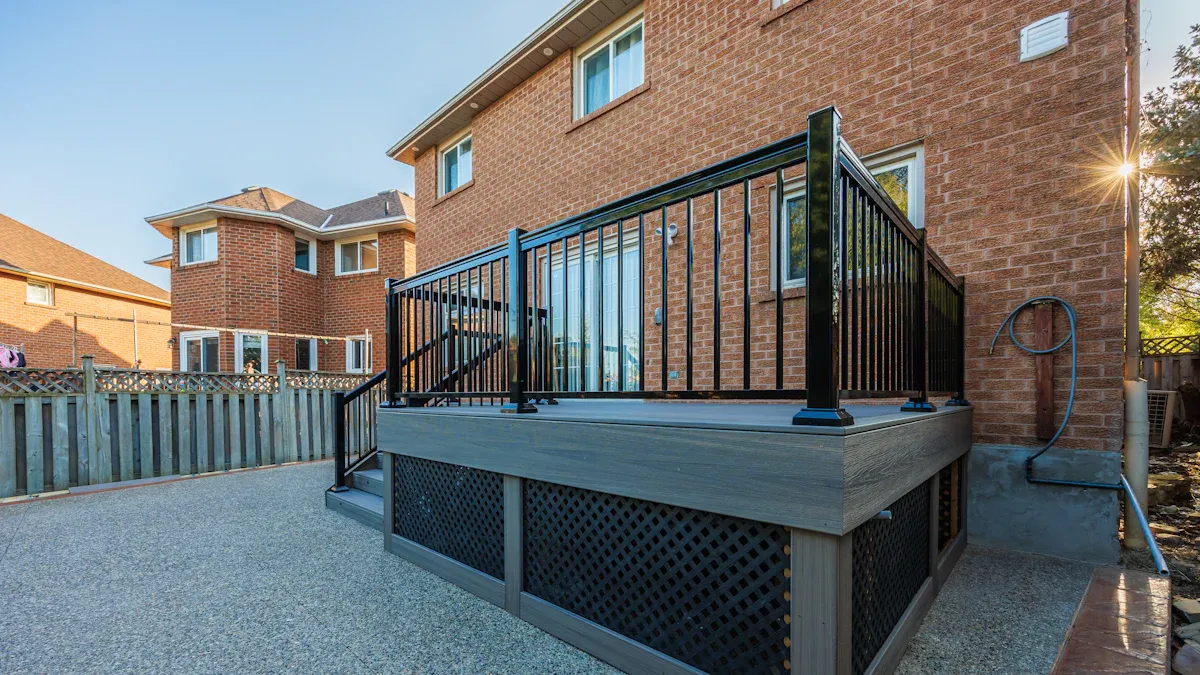
Composite wood offers consistent aesthetic appeal through a variety of finishes, colors, and textures. It provides greater customization with consistent aesthetics, unlike natural timber, which has inherent variations. Manufacturers engineer composite wood for unwavering durability. It resists warping, splintering, cracking, and insect damage. Unlike traditional wood, composite wood resists fading from UV rays, maintaining its vibrant color over time. Many composite decking products are scratch-resistant. This helps them maintain a like-new appearance even with heavy use. With UV inhibitors and waterproofing agents, composite wood retains its finish and integrity for years with minimal signs of aging. This ensures a longer-lasting enhancement to a property’s outdoor appeal. Modern composite wood decks mimic the natural beauty of real wood, with rich grains and refined colors. Innovative manufacturing processes help hues remain stable.
| Feature | Composite Wood (WPC) | Natural Timber |
|---|---|---|
| Appearance | Consistent from board to board, wide range of colors, textures, and realistic wood grain effects. | Rich grain patterns, traditional appeal, but with natural inconsistencies. |
| Design Flexibility | Greater customization with consistent aesthetics. | Inconsistencies may be less desirable in modern, uniform designs. |
| Verdict on Aesthetics | Provides greater customization with consistent aesthetics. | Offers unique character but with inherent variations. |
Composite timber cladding offers a uniform appearance with controlled grain patterns. It comes in a wide range of colors and finishes, including wood-look and modern grays. UV-resistant coatings prevent fading or blotching. Natural wood has natural variations. These variations can lead to uneven coloration over time, knots, splits, and grain inconsistencies.
Composite wood also provides extensive design flexibility for outdoor spaces. Installers prepare the decking area by measuring and marking the installation area. They ensure proper clearance from structures and prepare the ground by leveling and clearing debris. For a stable foundation, digging post holes and pouring concrete footings may be necessary. Maintaining proper drainage is crucial to prevent water damage. This requires a 1% grade (an eighth-inch drop per foot) to direct rainfall away from the deck. The framework, or 'skeleton,' consists of horizontal joists connected by vertical posts resting on concrete footing pads. Proper joist centers are essential for stability. Once the frame is in place, installers lay composite boards. It is critical to maintain proper spacing (about 3mm or the thickness of two quarters) between boards. This allows for natural movement due to temperature and humidity changes. Controlling deck seams is also important for aesthetics and to prevent weak points. For a sleek finish without visible screws, hidden fasteners attach securely to the deck frame. They grip special cavities within each board end. This ensures durability while preserving visual appeal. Finishing touches enhance appearance and functionality with elements like fascia finish, post caps, and deck railings. These improve aesthetics and protect the deck's structure from moisture and debris, ensuring longevity.
Homeowners can choose from numerous design patterns:
- Single-Width Deck Pattern: This is the easiest and most cost-effective to install. Boards are typically spaced 16 inches on center. It is also known as the horizontal deck pattern and is ideal for budget-conscious homeowners seeking a subtle design.
- Diagonal Decking Pattern: Installers place boards at a 45-degree angle across the joists. This increases frame strength and prevents racking. It requires more labor due to increased cuts and may necessitate reducing joist spacing to 12 inches on center for support. This pattern adds sophistication and can emphasize views or direct movement.
- Picture Frame Deck Pattern: This involves running decking boards around the perimeter of the deck. It creates an artistic border. It can be added to any design and stands out with contrasting colors. With careful planning, it can be executed with minimal cost and material waste.
- Transition Board Deck Pattern: These boards create a bridge between two areas or elements on a deck. They signify a physical shift or a change in board orientation. They offer flexibility to tailor appearance and functionality, such as separating areas or adding visual interest to long runs.
- Herringbone Deck Pattern: This pattern symbolizes luxury. It requires highly skilled craftspeople and often significant subframe upgrades. It can be time-consuming and costly but yields exceptional results with experienced installers and premium materials.
- Chevron Deck Pattern: A simplified version of herringbone, it creates a zig-zag effect by alternating board directions. Boards are typically at a 90-degree angle, with boards cut at 45-degree angles and butted together. It requires precise cuts and subframe upgrades, making professional installation advisable.
- Staggered Deck Board Pattern: This resembles brickwork. Boards are repetitively and alternately joined across the deck surface. It breaks up the appearance of long boards and can achieve a modern aesthetic. It uses a simple subframe, similar to other straightforward patterns.
- Tile or Patchwork Deck Pattern: This offers an innovative approach to creating an elegant outdoor space that appears larger. It uses varying patchwork sizes and geometric arrangements. This pattern requires a complex sub-structure and detailed planning, often best executed by experienced contractors.
- Curved Deck Pattern: This is popular due to advancements in materials and curving equipment. It allows for imaginative and unique designs. It requires more effort and planning than standard decks, including specialized subframes and equipment. It often necessitates working with experienced professionals.
- Deck Inlay Pattern: This is a creative way to add flair using contrasting colors, angles, and shapes. Inlays are challenging, time-consuming, and can result in material waste. They require significant vertical blocking between joists and attention to detail.
Manufacturers ensure color consistency across different production batches. They recommend using the same batch number for a job. If different batch numbers are present, they advise mixing all batches together to achieve uniform color. Efficient batch production processes ensure consistency and high quality in composite wood products, including color. Manufacturers address color consistency by implementing dust removal systems and strict quality checks during production. These measures help eliminate impurities and ensure that every batch of composite wood is uniform. Top-quality suppliers guarantee strict quality control and batch uniformity for their wood plastic composite material products. This ensures consistent color between different shipment lots. An integrated manufacturing process ensures rigorous quality control from raw material to finished product. This guarantees uniform color, texture, and dimensions across all batches for large projects, including a wpc garden fence.
A Sustainable Choice for the Planet
Composite wood products represent a sustainable choice for the planet. They often incorporate significant amounts of recycled materials. Eco-Certified™ Composites (ECC) require products to contain either a minimum of 75% recycled or recovered fiber OR at least 50% recycled or recovered fiber AND a minimum of 5% post-consumer fiber. The BIFMA e3-2014e Furniture Sustainability Standard, which ECC mills may help achieve, includes criteria for Recycled Content at 30% and 50%. Terratek WC wood-plastic composites can contain up to 60% wood particles. The plastic materials used in Terratek WC can be sourced from post-industrial or post-consumer recycling. The Terratek WC 100300 formulation specifically contains approximately 30% wood fibers and 70% reclaimed polypropylene.
Manufacturers of composite wood products hold various certifications for sustainable sourcing and production. These certifications ensure environmental responsibility throughout the product lifecycle.
- Composite Panel Association (CPA) ECC Certification: This sustainability standard applies to manufacturers of composite wood or agrifiber-based panels. It involves using the CPA Carbon Calculator to assess the lifecycle and carbon footprint of composite panels.
- LEED V4 Credit Support: Manufacturers can qualify for LEED Credits, particularly in the Low-Emitting Materials Category. This contributes to the widely used green building rating system.
- Forest Stewardship Council (FSC) Chain of Custody (CoC) Certification: This certification ensures products are made from materials sourced from well-managed FSC-certified forests and other controlled sources. It promotes environmental, social, and economic benefits. It allows for labeling products to indicate responsible forest management.
- UL Environmental Product Declaration (EPD): An EPD measures and analyzes the carbon impacts of a product through a Life Cycle Assessment (LCA). UL EPD certification indicates independent review and certification of the manufacturer’s environmental impact disclosure for products like hardwood plywood, softwood plywood, and MDF.
- Sustainable Forestry Initiative (SFI): A North American program ensuring sustainable forestry practices.
- Canadian Standards Association (CSA): The Canadian National Forest Management Standard.
- American Tree Farm System (ATFS): Geared towards smaller U.S. landowners, ensuring sustainable forestry practices.
These systems encompass three types of forest-related certification: forest management standards, wood fiber sourcing standards, and chain of custody standards. They require landowners to follow sustainable practices, prevent controversial wood sources, and track certified materials through the supply chain.
Manufacturers also adhere to CARB Certification and EPA TSCA Title VI. These certifications verify the amount of formaldehyde emitted by composite wood products. They ensure compliance with regulations that set emission limits for hardwood plywood, particle board, and medium density fiberboard (MDF). UL Solutions acts as a third-party certifier for these standards.
While composite wood offers many environmental benefits, it is important to consider its carbon footprint during production.
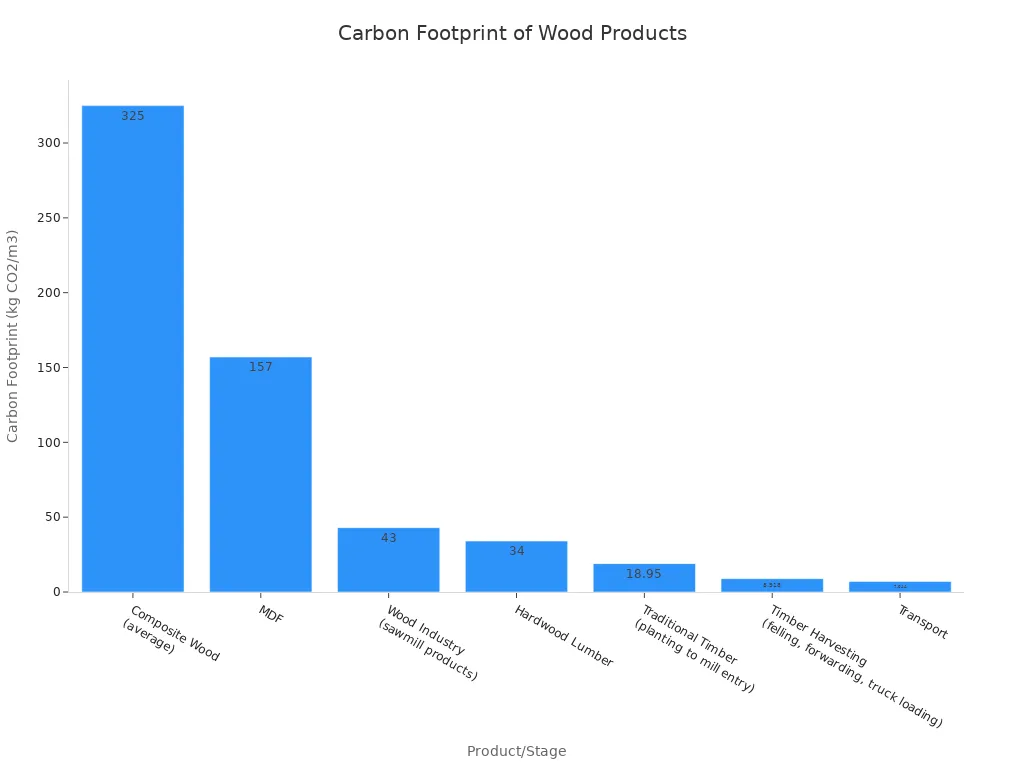
The chart above illustrates the carbon footprint of various materials. Composite wood has a higher carbon footprint during its production phase compared to traditional timber. However, its extended lifespan and reduced maintenance requirements contribute to a lower overall environmental impact over the product's entire life cycle.
Composite wood unequivocally surpasses timber for decking and fencing. It offers superior durability, minimal maintenance, and enhanced aesthetic appeal. This material represents a smart, sustainable investment. It significantly enhances outdoor living experiences for many years. Homeowners choose composite wood for a beautiful, resilient, and eco-friendly outdoor space.
FAQ
What is the typical lifespan of composite wood compared to timber?
Composite wood typically lasts 25-30 years or more. Traditional timber usually requires replacement after 10-15 years. This makes composite a longer-lasting investment.
Does composite wood require special cleaning or maintenance?
No, composite wood requires minimal maintenance. Homeowners simply clean it with soap and water. It does not need painting, staining, or sealing, unlike timber.
Is composite wood an environmentally friendly choice?
Yes, composite wood is a sustainable option. Manufacturers often use recycled materials in its production. This reduces waste and helps conserve natural resources. ♻️